
Mark Cuban says 90% of startups fail, but the bigger question is: what actually counts as a startup?
Is your neighbor’s bakery a startup? What about an app built by a college student? The difference matters because startups and small businesses follow very different paths for growth, funding, and success.
This article explains what a startup is, how it works, how it gets funded, and whether building one is the right path for you.
What Is a Startup Company?
A startup company is a young business designed for rapid growth by solving problems in new ways.
Unlike small businesses, startups prioritize experimentation, speed, and big markets, accepting a more uncertain growth model.
Think of it this way: your local pizza shop wants to serve great food to the neighborhood. A startup aims to transform the way millions of people eat, work, and live. That’s the fundamental difference.
People confuse any new business with a startup. But there’s a huge gap between opening a consulting firm and building the next Facebook. One follows a proven playbook. The other is writing a new one.
Types of Startups
Startups don’t all look the same. They’re often grouped by their focus area or growth stage.
By Focus:
- Tech startups: Build software, apps, or platforms. Examples: Slack, Notion, Figma
- Fintech startups: Focus on financial services. Examples: Stripe, Razorpay, Robinhood
- Healthtech startups: Work on healthcare solutions. Examples: Practo, Niramai
- Edtech startups: Improve how people learn. Examples: Byju’s, Coursera, Duolingo
- Consumer startups: Sell products or services directly to individuals. Examples: Warby Parker, Glossier
- B2B startups: Sell to other businesses. Examples: Salesforce, Zoho
By Stage:
- Pre-seed: Just an idea or early prototype. Usually self-funded
- Seed stage: First real product, first users, first outside investment
- Early stage (Series A): Product is working, now figuring out how to grow it
- Growth stage (Series B/C): Scaling fast, expanding teams and markets
- Late stage: Getting ready for an IPO or acquisition
How Is a Startup Different From a Small Business?
This is probably the most common point of confusion. Both are new. Both have small teams. Both are trying to make money. But they’re fundamentally different in what they’re trying to build.
| Factor | Small Business | Startup |
|---|---|---|
| Growth goal | Steady, sustainable | Rapid, large-scale |
| Business model | Proven from day one | Still being tested |
| Funding | Savings, bank loans, and early revenue | Angel investors, venture capital |
| Market size | Local or niche | Large, often global |
| Risk level | Manageable, predictable | High, accepted intentionally |
| Success metric | Profit, cash flow | User growth, retention, market share |
| Team roles | Defined, stable | Overlapping, flexible |
A small business wants to serve its community well and make a consistent profit. A startup wants to change how an entire industry works and do it at scale.
Neither is better. They’re just different goals that require different approaches.
Quick check: If staying small and profitable would make you happy, a small business might suit you better than a startup.
What Are the Key Characteristics of a Startup?
Not every new business is a startup. These traits separate startups from the rest.
- Solves a real problem in a new way: Startups don’t just enter markets; they change how things work entirely.
- Built for non-linear growth: A software product built once can serve a million users at almost the same cost as serving ten.
- Targets a large market: Uber didn’t focus on just one city. It thought about global transportation from day one.
- Tests fast, learns faster: The goal is never the perfect product. It’s the fastest path to real feedback.
- Uses data to make decisions: Customer acquisition cost, retention, and lifetime value. These numbers guide every major call.
- Comfortable with uncertainty: Startups accept that the plan will change. That’s not a flaw in the model. That’s the model.
How Startups Get Funded?
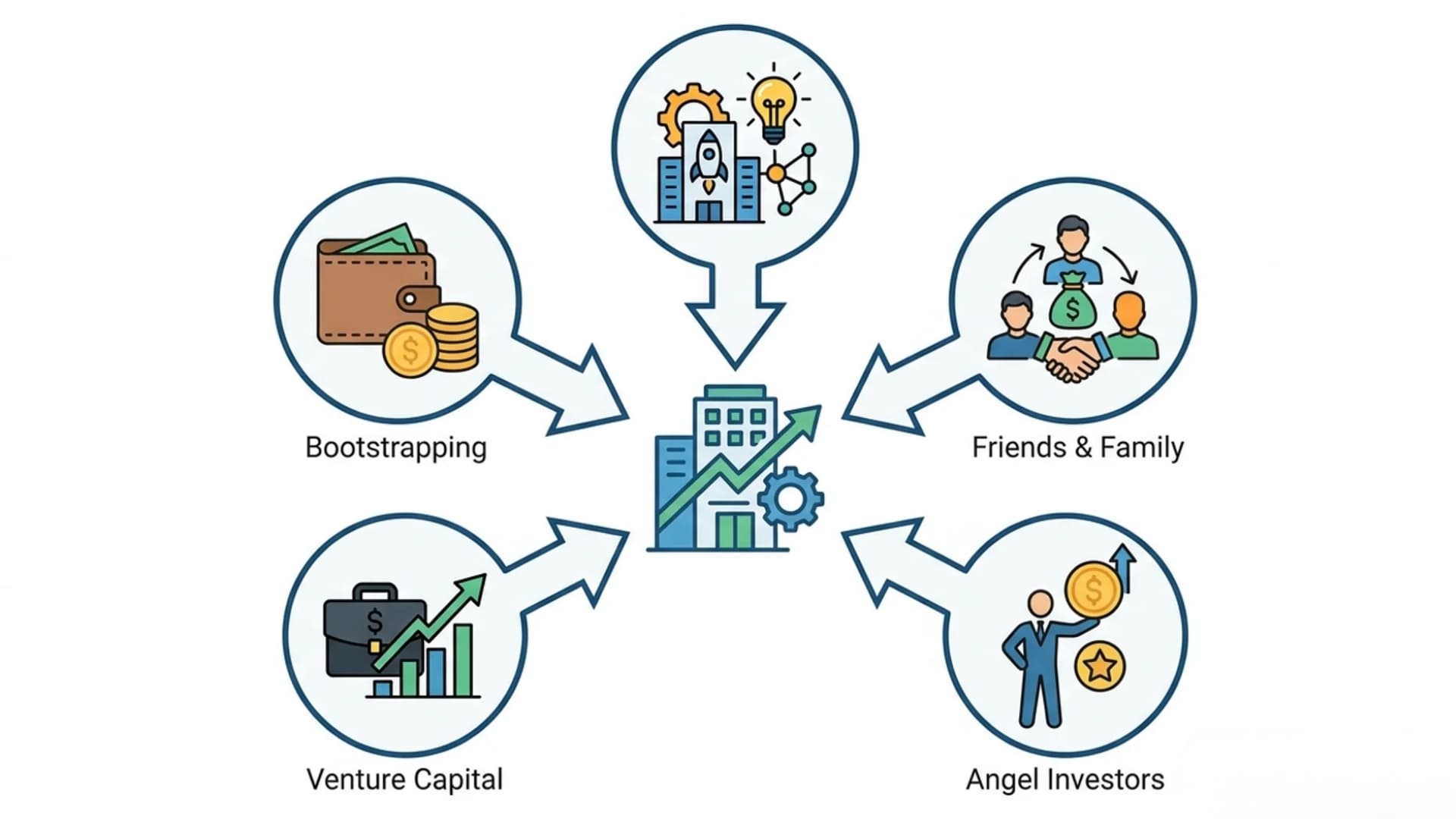
Most startups can’t grow on revenue alone in the early days. They need outside capital. Here’s how funding usually works:
1. Bootstrapping
You fund the business yourself, using savings, early customer payments, or revenue. You keep full ownership. Growth is slower, but you make your own decisions. Mailchimp ran this way for years before becoming a billion-dollar company.
2. Friends and Family
Early-stage founders sometimes raise small amounts from people who trust them. It’s useful for initial tests, but it’s rarely enough to build a real product.
3. Angel Investors
Wealthy individuals who invest their own money in early-stage startups. They typically write checks ranging from $25,000 to $500,000. Many also provide advice and connections alongside the money.
4. Venture Capital (VC)
Venture capital is professional investment firms that raise money from institutions and invest it in startups with high growth potential. Seed rounds often range from $500,000 to $2 million. Series A rounds typically go from $2 million to $15 million or more.
5. Accelerators and Incubators
Programs like Y Combinator and Techstars provide startups with small amounts of funding, mentorship, and resources in exchange for equity. They also provide access to a network of investors and founders.
6. One Thing to Understand About Equity
When you raise money, you give investors a percentage of your company. If you raise $500,000 for 10% equity, the investor now owns 10% of everything, future profits, decisions, and the sale price if you ever sell. Raising money too early or at a bad valuation can cost you a lot more than it’s worth.
How to Launch a Startup: Step by Step
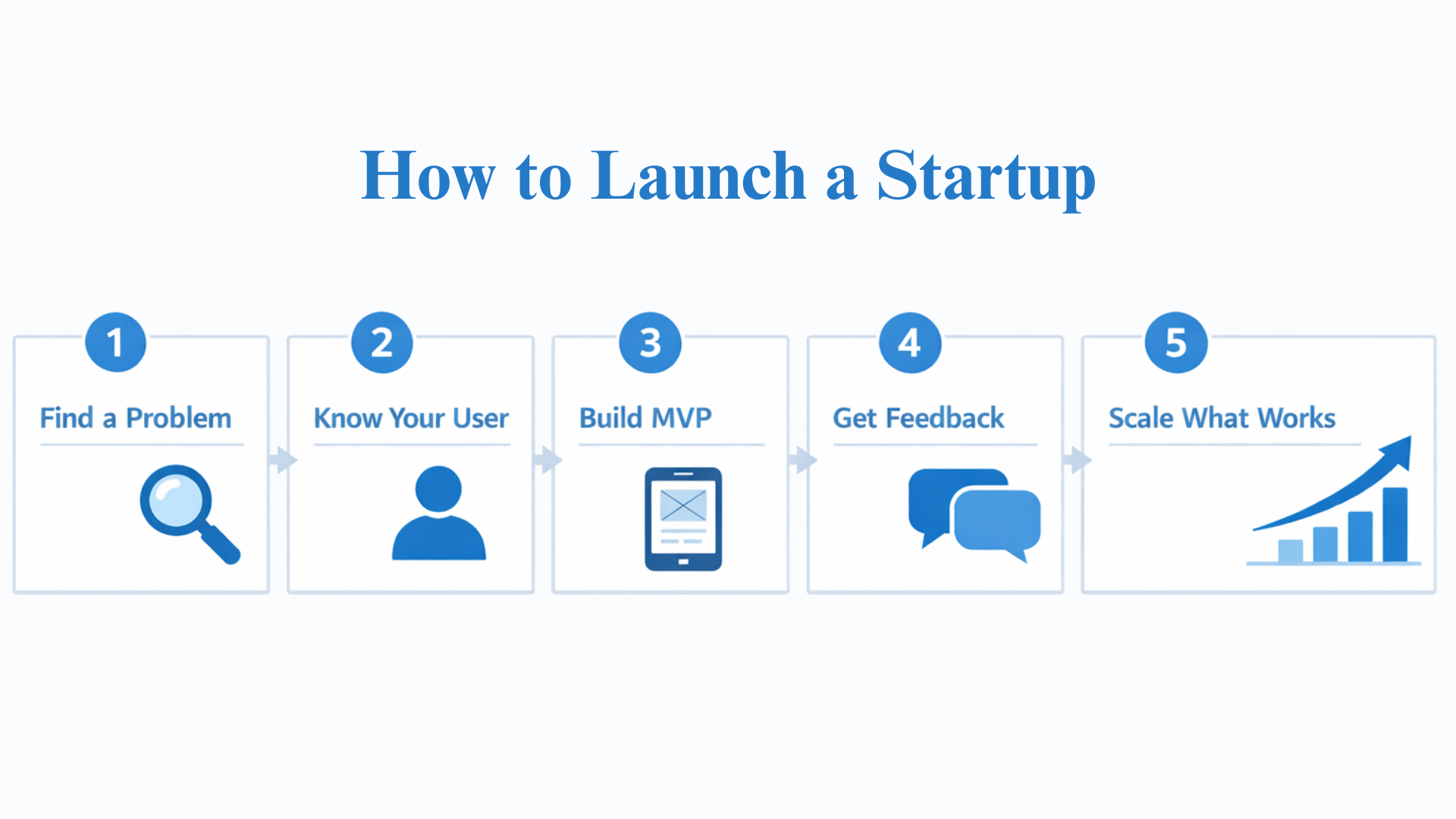
Launching a startup doesn’t begin with a big idea. It starts with a real problem and a willingness to test your assumptions before building anything serious. Here’s how successful startups actually get off the ground.
Step 1: Find a Real Problem Worth Solving
Don’t assume you know what frustrates people; go ask them. Talk to at least 10 to 15 potential users before you write a single line of code or design anything.
Look for problems that come up repeatedly and for which people are already spending time or money trying to fix on their own.
If someone has built a messy workaround, a spreadsheet, a group chat, or a manual process, that’s usually a sign the problem is real and painful enough to build around.
Step 2: Know Exactly Who You’re Building For
Once you’ve found the problem, get specific about who has it most. Not “young professionals” think more like “first-time managers at companies with under 50 people.”
The narrower your target, the sharper your product decisions become. Your messaging gets clearer. Your early outreach gets easier. And your first users feel like the product was built specifically for them, because it was.
Step 3: Build and Test Your MVP
Build the smallest version that honestly tests your core idea, nothing more. Airbnb’s founders didn’t build an app first. They rented out air mattresses in their own apartment during a conference just to see if strangers would actually pay to stay in someone else’s space.
That single test told them more than months of planning ever could have. Your MVP doesn’t need to be polished. It needs to answer one question: do people want this enough to use it?
Step 4: Get Real Feedback From Real Users
Don’t test with friends and family; they’ll be too kind. Find people who don’t know you, put the product in front of them, and watch what they actually do. Are they confused at step two?
Do they skip a feature you thought was important? Do they keep coming back on their own? Behavior tells you far more than any survey or conversation will. Track it closely and take notes on everything.
Step 5: Measure, Adjust, and Scale What Works
Look at the numbers that actually matter: are people returning, referring others, or willing to pay? Cut what nobody uses and put your energy behind what’s showing real traction.
Once a specific user group or use case is clearly working, focus on that exclusively. Spreading yourself across too many directions at once usually means making real progress in none of them.
How Do Startups Actually Make Money?
This is where many startups get stuck. Having a great product isn’t enough; you need a way to charge for it that makes sense.
- SaaS (Software as a Service): Customers pay monthly or yearly (e.g., Salesforce). Predictable recurring revenue; success depends on retention and low churn.
- Marketplace: Connect buyers and sellers, take a percentage (e.g., eBay, Airbnb). The challenge is liquidity, getting both sides active.
- Freemium/Product-led: Offer a free core, charge for premium features (e.g., Dropbox). Win by converting free to paid via clear value creation.
- Usage-based / API: Customers pay for what they use (e.g., AWS). Pricing aligns to delivered value; watch unit economics and predictability.
- E-commerce: Sell physical or digital products directly. Examples: Warby Parker, Bombas. Margins can be thin, so scale and efficiency matter a lot here.
Tip: Don’t just pick a model because it sounds good. Test pricing early. What someone says they’ll pay and what they actually pay are often very different.
The Real Challenges of Running a Startup
| Challenge | What It Actually Means |
|---|---|
| Running out of money | Cash runs out faster than expected. Track your runway weekly, not monthly. |
| Finding product-market fit | People need to want your product badly enough to pay and refer others. Most founders underestimate how long this takes. |
| Hiring the right people | One bad early hire can slow you down by months. Small teams have no room for the wrong fit. |
| Staying focused | Good ideas will distract you constantly. Saying no is harder than it sounds and more important than most founders admit. |
| Founder burnout | The hours are long, and the pressure is constant. Energy management is a skill; treat it like one. |
| Competition | Being first means nothing if you stop moving. Real user loyalty is your only durable advantage. |
Is a Startup the Right Path for You?
If you can live with little income for 2-3 years, make decisions when nothing feels certain, learn fast from failure, and genuinely want to build something for a large number of people, a startup might be the right fit.
But if steady income, predictable growth, and serving a specific community well are what actually excite you, a small business will likely make you far happier.
Be honest with yourself about which one you’re actually describing when you picture success.
Wrapping It Up
A startup is not just a new business. It’s built to grow fast, test ideas quickly, and solve problems at scale.
Understanding what a startup is and how it differs from other businesses helps you choose the right path.
If you’re starting one, find a real problem, talk to potential users, and build the simplest version that tests your idea. Learn from feedback, adjust quickly, and keep improving.
Frequently Asked Questions
Why do 90% of startups fail?
Most startups fail because they run out of funding, lack customer demand, face strong competition, or fail to build a product people need.
How do startups make money?
Startups make money by selling products or services through models like subscriptions, e-commerce, marketplaces, advertising, or licensing.
What does a start-up company do?
A startup develops a new product, service, or solution to solve a problem and aims to grow quickly in a larger market.
Do I need an LLC for a startup?
No, an LLC is not required. Many startups choose an LLC or corporation based on their legal, tax, and funding goals.
What business has a 90% success rate?
No business has a guaranteed 90% success rate. A company’s success depends on market demand, planning, execution, and adaptability.
Is doing a startup worth it?
A startup can be worthwhile if you want to build something scalable and can handle uncertainty, risk, and the challenges of entrepreneurship.