A broker license lets you work independently, supervise agents, and open your own brokerage. The process involves meeting experience requirements, completing coursework, passing the exam, and submitting an application.
This covers the steps, costs, timeline, and common mistakes to help you complete the process smoothly.
What Does a Real Estate Broker License Allow You to Do?
A broker license allows you to work independently, collect commissions directly from clients, supervise sales agents, and operate a brokerage. A sales agent cannot do any of these without a supervising broker attached to their license.
The Real Difference Between an Agent and a Broker
A real estate agent holds a base-level license and must work under a broker, with commissions paid through the brokerage. A broker earns an advanced license through experience, education, and an exam, allowing independent work and supervision of agents.
| Feature | Real Estate Agent | Real Estate Broker |
|---|---|---|
| License level | Entry level | Advanced |
| Works independently | No, must work under a broker | Yes, in most states |
| Collects commissions directly | No | Yes |
| Can supervise agents | No | Yes |
| Can open a brokerage | No | Yes, if state requirements are met |
| Experience required | None beyond the license exam | Years as a licensed agent plus extra coursework |
| US median wage (BLS, 2024) | $56,320 | $72,280 |
Types of Real Estate Broker Roles
Not every broker opens their own firm. There are four main roles after you earn a broker license.
- Associate broker: Holds the broker license but continues working under an existing brokerage. This is the least disruptive path for agents still building sales volume.
- Managing broker: Oversees a team of agents inside an established firm. Responsibilities include transaction review, compliance, and agent support.
- Designated broker (broker of record): Legally responsible for the brokerage and all agent activity under it. Each brokerage must have one.
- Broker-owner: Owns and operates an independent brokerage. Requires business registration, errors and omissions insurance, trust account setup, and written office policies in addition to the license itself.
Decide which path fits your career goals before you apply. Getting a broker license and opening a brokerage are two separate decisions. The license gives you the option. It does not require you to act on it immediately.
State terminology: In North Carolina, Washington, and Illinois, entry-level agents are called “brokers” or “provisional brokers.” In those states, the equivalent of an advanced broker license has a different title. Always check your state’s specific terminology with your state real estate commission before comparing requirements.
Requirements to Get a Broker License
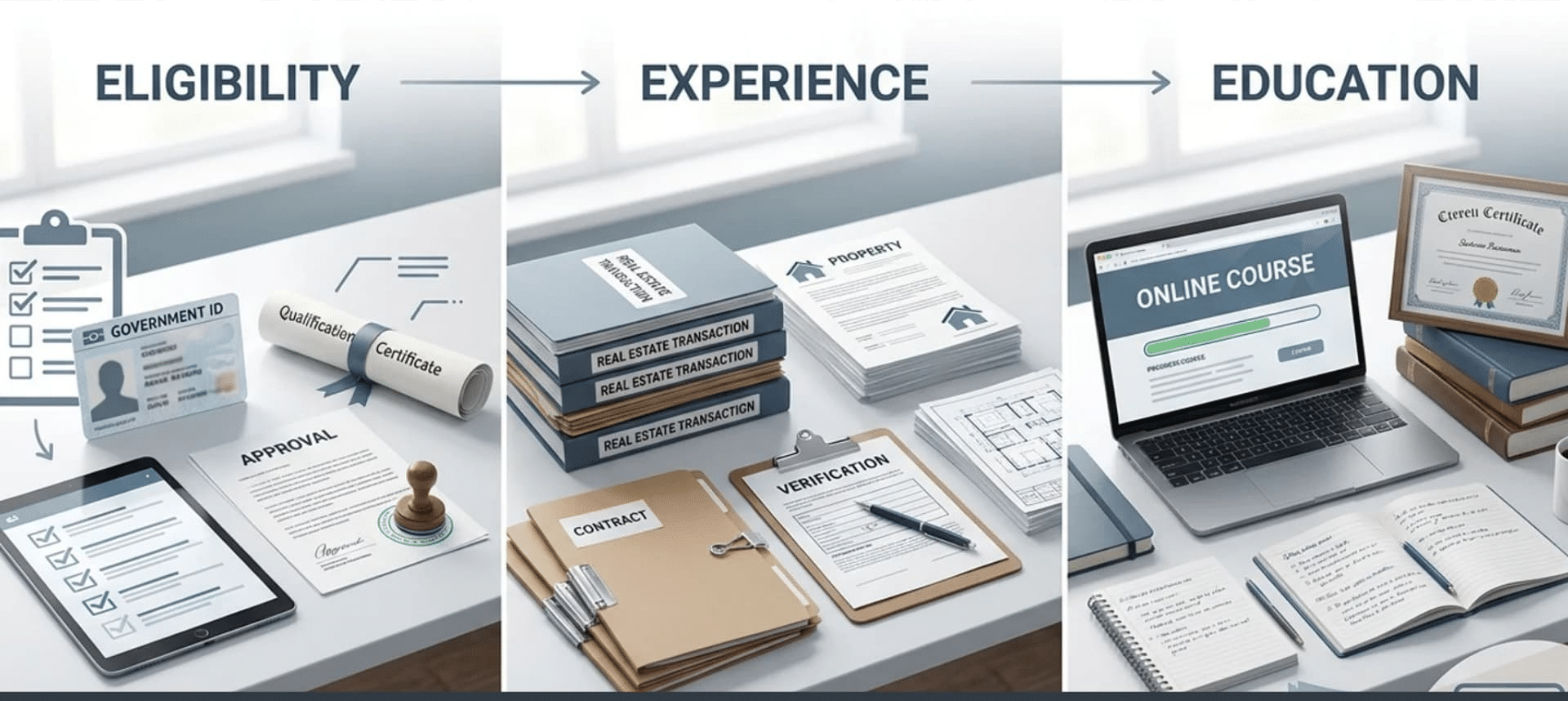
Broker license requirements vary by state, but most follow the same framework: eligibility, experience, and education requirements.
Age and Basic Eligibility
Most states require applicants to be at least 18 years old, though some set the minimum at 21. Most states require a high school diploma or equivalent, while a college degree is not necessary.
Experience as a Licensed Salesperson
Most states require two to four years of active experience as a licensed real estate agent. Active means working under a broker and completing real estate transactions. Some states use transaction-based systems or accept related experience such as property management.
Keep records of your transactions from the start. Experience verification is a common reason applications are delayed, and most states require broker approval of your transaction history.
Broker Pre-Licensing Education Hours
Education requirements differ widely by state. Examples include:
| State | Required Broker Coursework |
|---|---|
| Florida | 72-hour broker course + 60-hour post-license course |
| Texas | 270 hours pre-licensing + 630 related hours |
| California | 8 college-level courses (~360 hours) |
| New York | 152 hours of qualifying education |
| Most states | 45–90 hours of broker coursework |
Always check your state real estate commission’s website for the latest requirements before enrolling.
How to Get a Broker License: 7 Steps
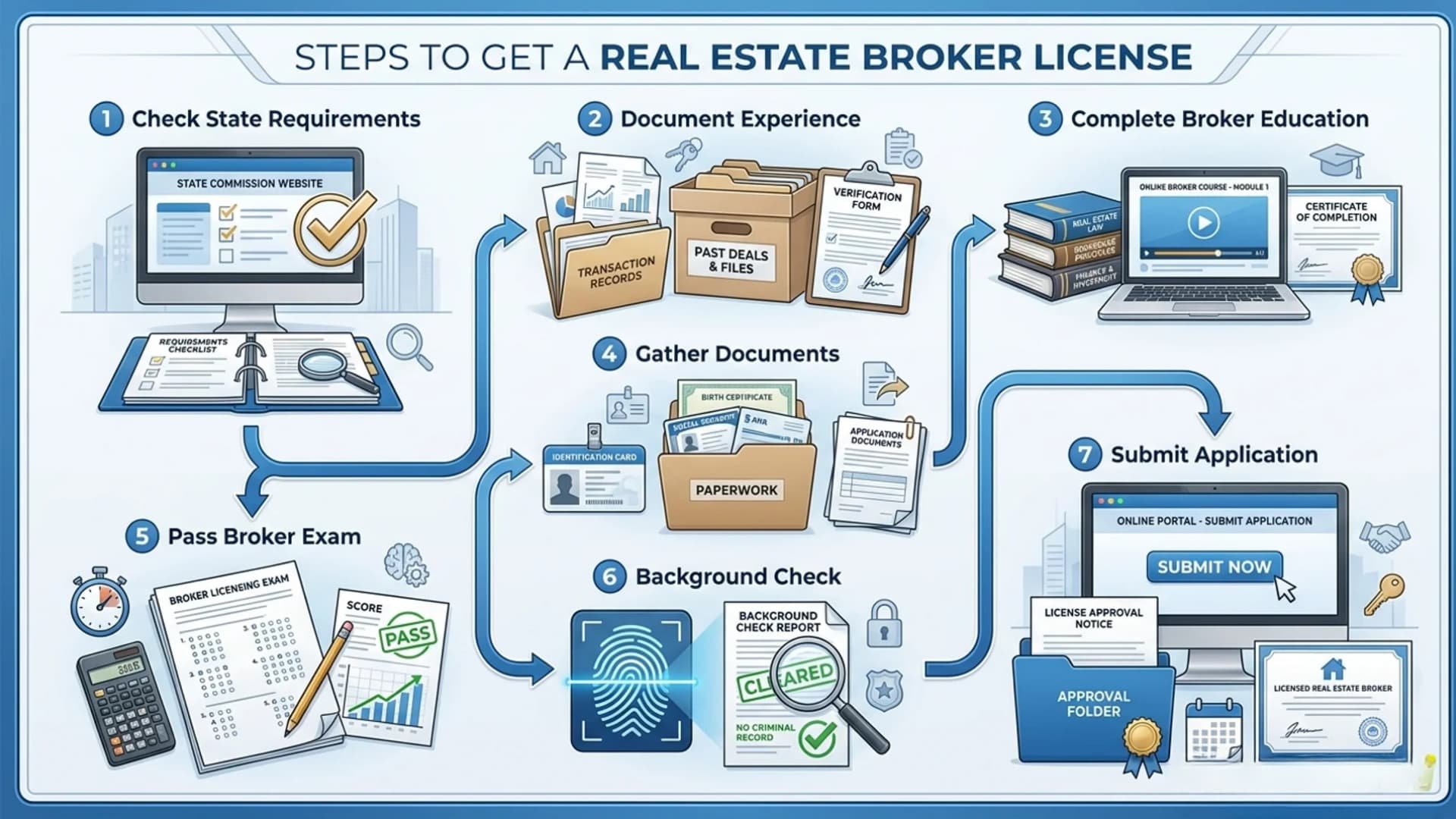
Follow these seven steps to move from a real estate agent to a licensed broker.
Step 1: Check Your State’s Requirements
Start by confirming your state’s broker licensing rules. Requirements for experience, education hours, exams, fees, fingerprinting, and reciprocity vary by state.
Visit your state real estate commission’s website to verify eligibility, course requirements, exam details, and background check rules. If you have a criminal record, check whether your state offers a preliminary fitness review before investing in courses.
Step 2: Document Your Experience
Collect your transaction history before applying. Most states require your supervising broker to verify your qualifying experience through a state-approved form.
Keep records of closed deals, dates, transaction types, and file numbers. Missing experience verification is one of the most common causes of application delays.
Step 3: Complete Broker Pre-Licensing Education
Enroll in a state-approved broker course after confirming your eligibility. These courses cover advanced topics such as brokerage management, real estate law, contracts, ethics, risk management, and agent supervision.
Choose an approved provider that fits your schedule and save your completion certificate for your application.
Step 4: Gather Your Documents
Prepare all required documents before scheduling your exam. Most applications require:
- Broker course completion certificate
- Current salesperson license
- Experience verification form
- Transaction history
- Government-issued ID
- Fingerprinting confirmation
- Application fee
- Criminal history disclosures (if required)
Step 5: Pass the Broker Exam
After completing education, schedule your broker exam through your state commission or approved testing provider.
Most exams include national real estate principles and state-specific laws.
| Exam Feature | Typical Range |
|---|---|
| National questions | 80–100 |
| State-specific questions | 40–80 |
| Passing score | 65%–75% |
| Exam fee | $50–$200 |
Study tips:
- Focus on agency law, contracts, trust accounts, and state regulations.
- Take timed practice exams before test day.
- Study consistently for four to six weeks.
- Review your state’s retake rules if needed.
Step 6: Complete Fingerprinting and Background Check
Most states require fingerprinting and a background check for broker applicants. You may need to complete this again, even if you already completed fingerprinting for your salesperson license.
Costs typically range from $35 to $100 depending on the state-approved vendor.
Step 7: Submit Your Broker License Application
After passing the exam, submit your application through your state’s licensing portal. Include exam results, course certificates, experience verification, background check details, ID, fees, and required disclosures.
Processing times vary by state. Check your state’s application deadline after passing the exam to avoid delays.
Watch your deadlines. Some states require you to submit your full application within a set window after passing the exam, commonly 12 months. If you miss that window, you may need to retake the exam. Confirm your state’s deadline before you schedule the test.
How Much Does It Cost to Get a Broker License?
The total cost of getting a broker license ranges from $300 to $2,000 or more depending on your state and the course provider you choose. Budget across four main categories:
| Cost Item | Typical Range |
|---|---|
| Broker pre-licensing coursework | $200–$900 |
| Exam application fee | $50–$200 |
| State license application fee | $43–$485 |
| Fingerprinting and background check | $35–$100 |
| Optional exam prep materials | $50–$200 |
| Total estimated range | $300–$2,000+ |
State fees alone vary significantly. Florida’s license application fee runs around $43. Colorado and Connecticut sit near $485. Texas’s coursework requirement pushes total costs to $2,000 to $2,500 for most applicants. California sits around $920 in combined fees and course costs.
Always verify current fees on your state commission’s official website before budgeting. Fees change year to year.
How Long Does It Take to Get a Real Estate Broker License?
For most licensed agents, the full path takes three to five years measured from the day they first became a salesperson. The experience requirement drives that timeline. Once you qualify, the remaining steps take three to six months.
| Stage | Typical Duration |
|---|---|
| Active salesperson experience (state minimum) | 2–4 years (mandatory) |
| Broker pre-licensing coursework | 1–6 months |
| Fingerprinting and background check | 2–4 weeks |
| Exam preparation and scheduling | 4–8 weeks |
| Application processing to license activation | 2–8 weeks |
| Total (after meeting experience requirement) | 3–6 months |
Two things speed up the process after you qualify. First, complete your broker coursework online at your own pace while you are still working as an agent. Second, have all your documentation ready before you sit for the exam. Filing your application the day you pass cuts weeks off the timeline.
What to Do After You Get Your Broker License
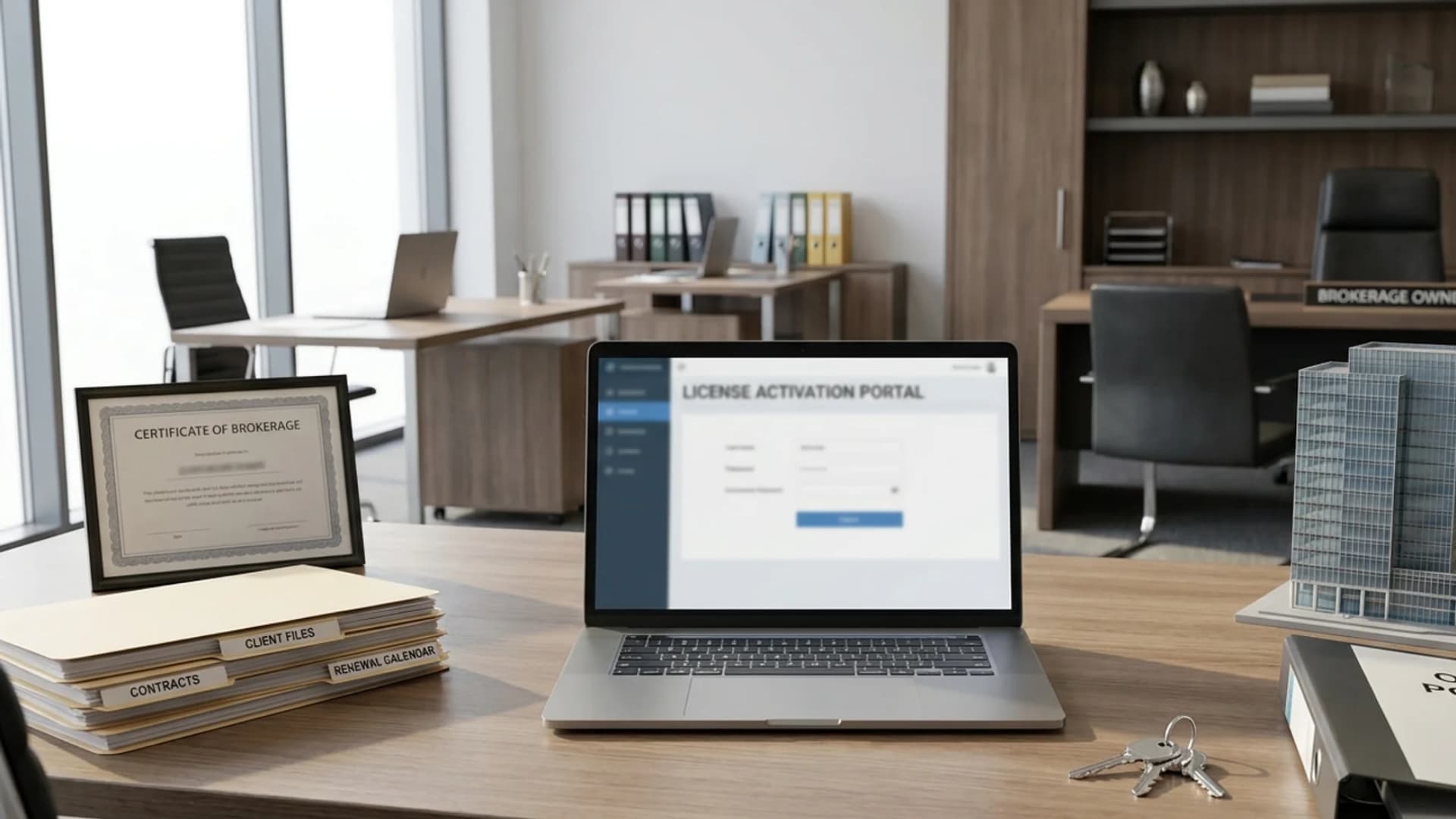
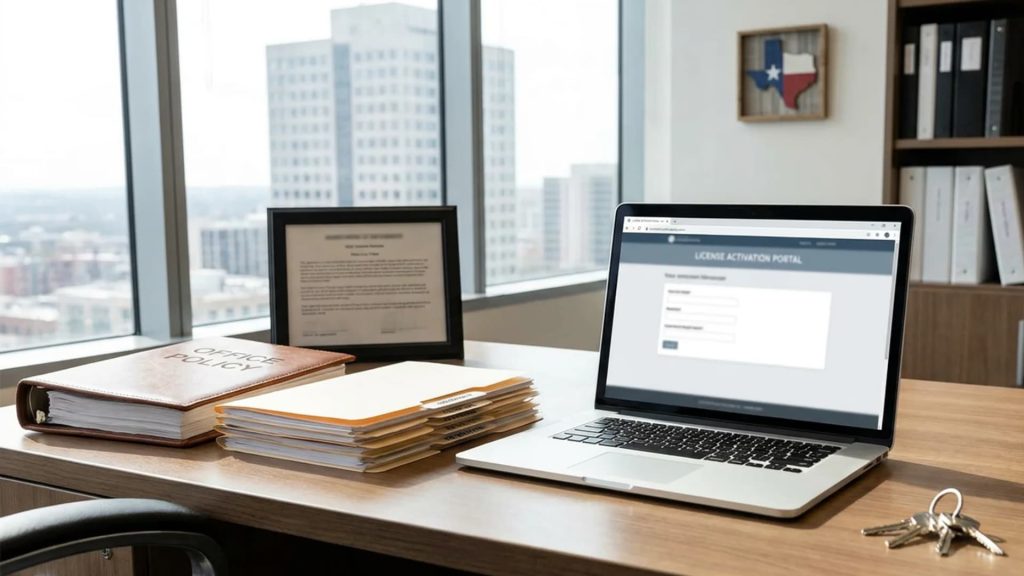
In most states, passing the exam does not automatically activate your broker license. You must complete activation through your state commission’s portal before you can legally represent clients or operate under broker authority.
Activate Your License
Log in to your state’s licensing portal and select either a sponsoring broker or designate yourself as an independent broker, depending on the path you have chosen. Activation typically takes a few business days. Until activation is confirmed, your license remains inactive.
Choose Your Broker Path
A broker license opens several career options. Picking the right one before you apply saves you from making expensive structural decisions in a rush after you pass.
- Associate broker: Work under an existing brokerage. Keep the credential without managing agents or running a business. A good option if you want credibility and independence without the overhead.
- Managing broker: Lead a team inside an established firm. You handle compliance, training, and transaction oversight without owning the brokerage. This role suits agents with leadership interest but no immediate plans to launch their own company.
- Independent broker: Work solo without a brokerage structure. You handle all compliance responsibilities yourself and work directly with clients without a firm behind you.
- Broker-owner: Open your own firm. This requires steps beyond the license: business entity registration, errors and omissions insurance, a dedicated trust account, written office policies, and a plan for recruiting and supervising agents.
Getting a broker license and opening a brokerage are two separate decisions. You do not have to start a firm the day your license arrives. You can work as an associate broker for years before making that move.
License Renewal and Continuing Education
Broker licenses require renewal on a set cycle, typically every one to four years depending on your state. Each renewal cycle requires a minimum number of continuing education hours covering topics like fair housing updates, ethics, state law changes, and brokerage practices.
Failing to complete CE on time results in license suspension. Check your state commission’s renewal schedule as soon as your license activates.
Common Mistakes When Applying for a Broker License
These errors show up repeatedly in real estate forums and state commission inquiry records. Most of them are avoidable.
- Not tracking transaction history from day one. Experience verification is the most common application bottleneck. Keep records of every closed deal throughout your salesperson career, not just when you decide to apply for your broker license.
- Enrolling in a course that is not approved in your state. Not every online real estate school is approved for broker coursework in every state. Verify the provider on your state commission’s website before paying.
- Choosing a course based only on price. The cheapest course may not include exam prep materials, have a strong pass rate, or offer student support. Pass rate data matters here because the broker exam is harder than the salesperson exam.
- Assuming fingerprints from your salesperson license are still on file. Most states require new fingerprints for the broker application, even if you already submitted prints for a previous license.
- Missing the application window after the exam. Some states require you to submit a full application within 12 months of passing the broker exam. Missing that window may require you to retake the exam. Confirm your state’s policy before scheduling your test.
- Treating the license as a business plan. Earning a broker license does not mean you must open a brokerage. Many new brokers make expensive business decisions too quickly after passing. Assess the associate broker or managing broker path first before committing to starting a firm.
- Underestimating the compliance responsibilities. A broker license comes with legal obligations. If you supervise agents, you are responsible for their contract accuracy, trust account handling, and regulatory compliance. Be prepared for this role before taking agents on.
Real Estate Broker License Reciprocity
Reciprocity allows brokers licensed in one state to skip some or all requirements when applying in another state. Not every state offers reciprocity, and the terms vary significantly.
Full reciprocity means you can apply in the partner state by submitting your existing license documentation without retaking the full exam. Partial reciprocity typically waives the national portion of the broker exam but still requires you to pass the state-specific section.
Reciprocity agreements change. A state that offered full reciprocity last year may have updated its rules. Always verify the current reciprocity status directly with the destination state’s real estate commission before assuming any requirement is waived. The commission’s official website is the only reliable source.
Frequently Asked Questions
Can you get a broker license without first being a real estate agent?
In most states, no. You must complete years of active salesperson experience first. Some states accept equivalent real estate work such as appraisal or property management in place of part of the experience requirement.
How long does it take to get a broker license after you qualify?
Three to six months after you meet the experience requirement. That includes coursework, exam preparation, and application processing time.
Is the broker exam harder than the real estate agent exam?
Yes. The broker exam is longer, covers more advanced topics, and has a lower pass rate than the salesperson exam. Focused preparation and timed practice tests significantly improve your chances.
Can you get a broker license with a criminal record?
A record does not automatically disqualify you. Most states review the nature, timing, and severity of the offense individually. Several states offer a preliminary fitness review before you invest in courses.
Do you have to open a brokerage to use a broker license?
No. You can work as an associate broker under an existing firm. Many brokers never open their own brokerage at all.
Getting Your Broker License in Texas
Getting a broker license follows a clear path: meet experience requirements, complete coursework, pass the exam, and submit your application. The timeline and costs vary by state, so always check your state commission’s rules first.
Keep track of your transactions from the start of your real estate career. Having your records and eligibility details ready can prevent delays when you apply.