
Closing costs on a home purchase can run between 2% and 5% of the price. That adds up fast.
Seller concessions let the seller pay a portion of those costs for you. The result is less cash out of your pocket on closing day.
On a conventional loan, the max seller concessions range from 3% to 9%. Your exact limit depends on your down payment, loan-to-value ratio, and property type. Investment properties follow a separate 2% cap.
Get the number wrong before you sign an offer and your lender will reject the terms. Know the exact cap before negotiations start.
This post covers the limits and how to calculate them. It also explains what costs qualify and the mistakes that cost buyers money at closing.
What Are the Max Seller Concessions on a Conventional Loan?
The max seller concessions on a conventional loan range from 3% to 9% for primary residences and second homes. Investment properties are capped at 2% regardless of down payment size. Your exact limit ties directly to your down payment and loan-to-value ratio.
Fannie Mae and Freddie Mac govern these rules. They base the concession limit on the lower of the sales price or appraised value. If the home appraises below the contract price, the lower figure controls the cap.
|
Property Type |
Down Payment |
Max Seller Concession |
|---|---|---|
|
Primary residence or second home |
Less than 10% |
3% |
|
Primary residence or second home |
10% to 25% |
6% |
|
Primary residence or second home |
More than 25% |
9% |
|
Investment property |
Any amount |
2% |
The lower your down payment, the tighter the limit. A larger down payment gives the seller more room to contribute at closing.
What Do Seller Concessions Cover on a Conventional Loan?
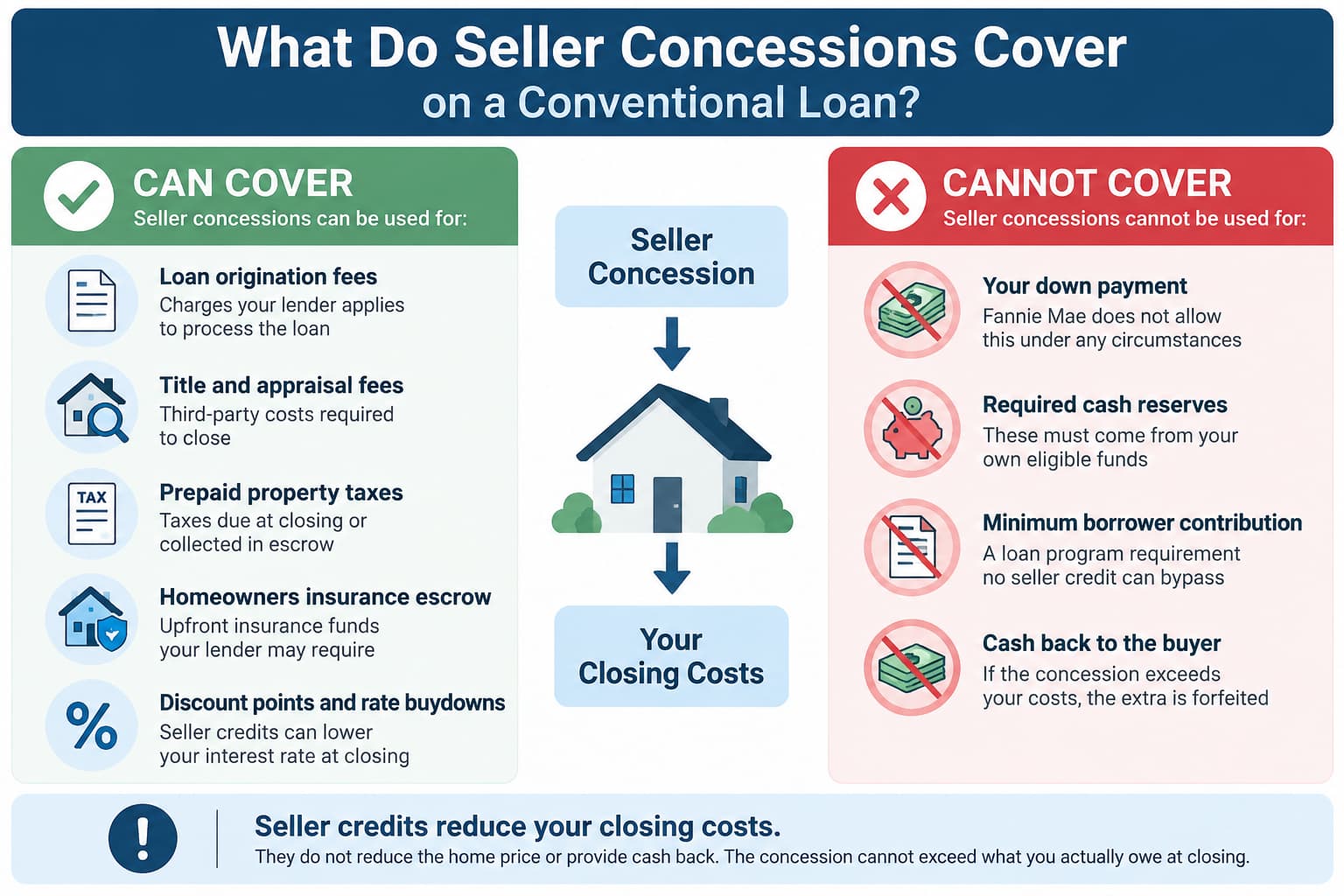
Seller concessions pay toward your eligible closing expenses. The seller does not cut the home price. Instead, they apply a dollar credit at closing. That credit reduces the cash you owe that day.
Costs seller concessions can cover:
-
Loan origination fees – charges your lender applies to process the loan
-
Title and appraisal fees – third-party costs required to close
-
Prepaid property taxes – taxes due at closing or collected in escrow
-
Homeowners insurance escrow – upfront insurance funds your lender may require
-
Discount points and rate buydowns – seller credits can lower your interest rate at closing
Costs seller concessions cannot cover:
-
Your down payment – Fannie Mae does not allow this under any circumstances
-
Required cash reserves – these must come from your own eligible funds
-
Minimum borrower contribution – a loan program requirement no seller credit can bypass
-
Cash back to the buyer – if the concession exceeds your costs, the extra is forfeited
The concession cannot exceed what you actually owe at closing. If the calculation gives you a higher number than your real costs, the surplus is lost. It does not come back to you as cash.
How Your Down Payment Determines the Limit
Your down payment is the key driver. A smaller down payment creates a higher loan-to-value ratio. A higher LTV tightens the allowed seller contribution. As your down payment grows, the LTV drops and the seller can contribute more.
Less than 10% down
Your LTV sits above 90%. The max seller concessions conventional lenders allow is 3%. On a $300,000 home, that is $9,000 toward closing costs.
10% to 25% down
Your LTV drops to the 75% to 90% range. The limit rises to 6%. On a $450,000 home, that is $27,000.
More than 25% down
Your LTV falls below 75%. You qualify for the 9% tier. On a $500,000 home, that is $45,000 at closing.
Investment properties
A flat 2% cap applies regardless of how much you put down. Lenders treat investment purchases as higher-risk transactions. The stricter limit applies across all down payment levels.
These caps exist for a reason. Lenders and mortgage investors need loan amounts that reflect actual home values. If seller concessions push the effective price above market value, it creates risk for the lender. It can also distort comparable prices in the neighborhood. The tiered limits keep contributions proportional to the deal.
How to Calculate Your Max Seller Concession Amount
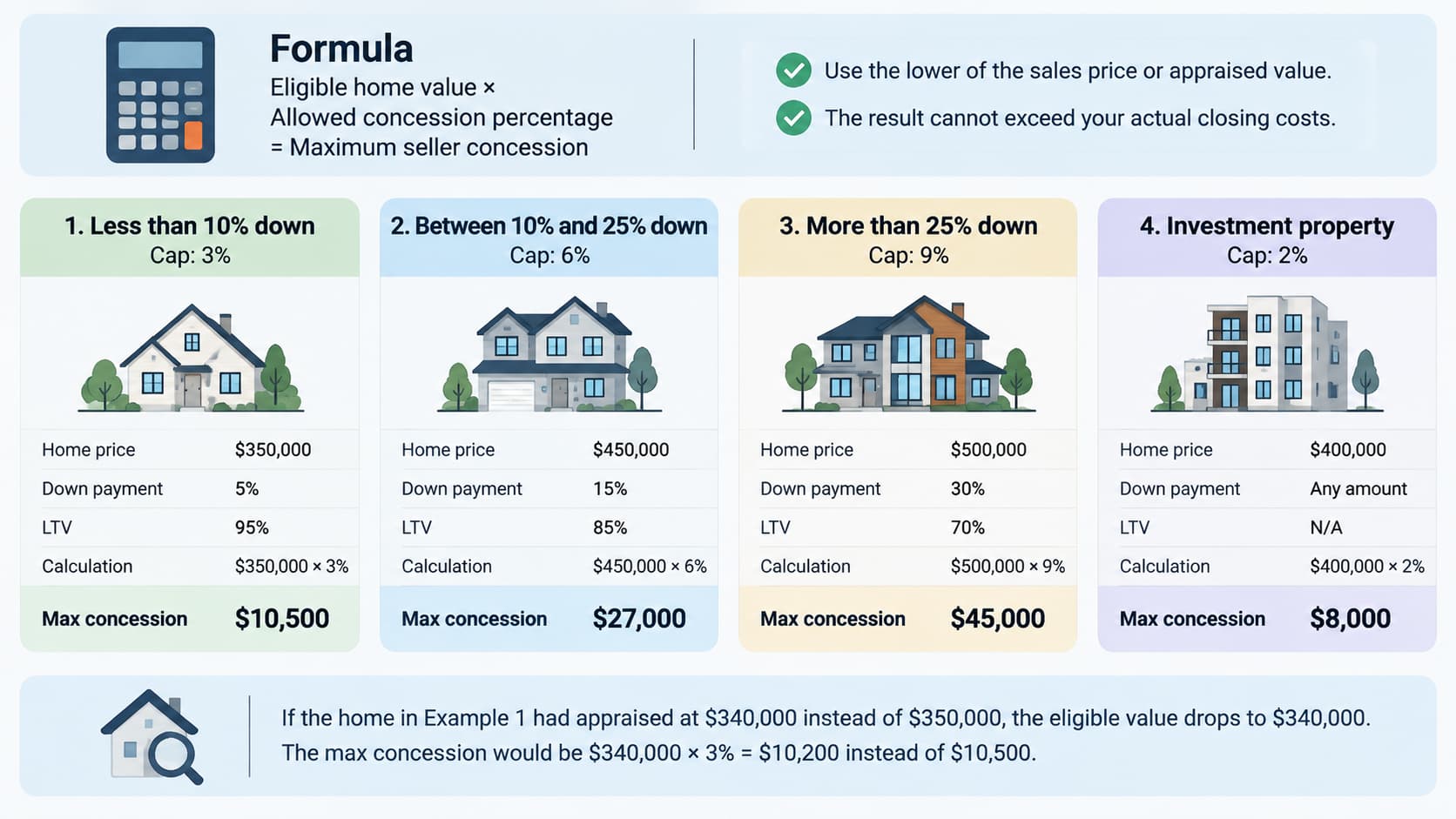
The formula is straightforward. Multiply the eligible home value by the allowed percentage for your down payment tier.
Formula: Eligible home value × Allowed concession percentage = Maximum seller concession
The eligible home value is the lower of the sales price or the appraised value. One more rule applies: the result cannot exceed your actual closing costs. If the math gives you $12,000 but your closing costs are $9,000, the seller can only contribute $9,000.
Example 1: Less than 10% down
Home price: $350,000. Down payment: 5%. LTV: 95%. Cap: 3%.
Maximum concession: $350,000 × 3% = $10,500
Example 2: Between 10% and 25% down
Home price: $450,000. Down payment: 15%. LTV: 85%. Cap: 6%.
Maximum concession: $450,000 × 6% = $27,000
Example 3: More than 25% down
Home price: $500,000. Down payment: 30%. LTV: 70%. Cap: 9%.
Maximum concession: $500,000 × 9% = $45,000
Example 4: Investment property
Home price: $400,000. Cap: 2% regardless of down payment.
Maximum concession: $400,000 × 2% = $8,000
If the home in Example 1 had appraised at $340,000 instead of $350,000, the eligible value drops to $340,000. The max concession would be $340,000 × 3% = $10,200 instead of $10,500. Always wait for the appraisal before finalizing concession terms.
Max Seller Concessions by Loan Type
Each mortgage program sets its own limits. Conventional loans start at 3% for low down payments. They climb to 9% for buyers who put more than 25% down.
|
Loan Type |
Max Seller Concession |
|---|---|
|
Conventional |
3% to 9% based on down payment |
|
FHA |
Up to 6% (flat cap) |
|
VA |
4% for specific categories |
|
USDA |
Up to 6% (flat cap) |
FHA and USDA both cap concessions at 6% regardless of how much you put down. VA allows 4% on specific cost categories, with standard closing costs handled separately.
If you put less than 10% down, FHA gives you more room than a conventional loan. Put more than 25% down and a conventional loan offers the highest seller contribution cap of any standard program.
Seller Concession vs. Price Reduction
A seller concession and a price reduction both lower your costs. But they work in different ways and serve different financial goals.
|
Option |
What It Lowers |
Best For |
|---|---|---|
|
Seller concession |
Cash needed at closing |
Buyers short on closing cash after the down payment |
|
Price reduction |
Purchase price and loan balance |
Buyers who want lower monthly payments long term |
A concession makes sense when you have the down payment covered but need help with closing day expenses. A price reduction makes more sense when you want a smaller loan balance and lower total interest paid over time.
Ask your lender to run both scenarios before the offer goes in. The right choice depends on your cash position and how long you plan to stay in the home.
Common Mistakes Buyers Make With Seller Concessions
These errors come up often and can delay or derail a closing.
-
Requesting more than the cap allows. Any amount above the limit will not be applied at closing. Your lender removes the excess. If the purchase agreement does not reflect the correct terms, the deal can stall.
-
Ignoring actual closing costs. If your costs come in lower than the concession amount, the leftover is lost. It does not convert to cash for you.
-
Forgetting the appraisal rule. If the home appraises below the purchase price, the concession calculates off the lower number. A low appraisal can shrink what the seller is allowed to contribute.
-
Assuming concessions cover the down payment. They do not. Fannie Mae rules are clear on this point. Your down payment and required reserves must come from your own eligible funds.
-
Not confirming limits with your lender first. Loan type and property use both affect the seller’s allowed contribution. Check with your lender before the offer is written. One wrong number in the offer can stall your deal or cost you money at the closing table.
Conclusion
The max seller concessions on a conventional loan follow a straightforward structure. Less than 10% down sets your cap at 3%. Between 10% and 25% gives you 6%. More than 25% qualifies you for 9%. Investment properties stay at 2% no matter what.
Run the calculation before you start talks with the seller. Use the lower of the purchase price or appraised value. Keep the request within your actual closing costs or the extra is forfeited.
Seller concessions can save you thousands on closing day. But they only work in your favor when you know the exact rules going in. Talk to your lender and confirm the figure for your specific loan. Then write the offer with the right number.
Frequently Asked Questions
What is a 4% seller concession?
A 4% seller concession means the seller covers 4% of the home’s purchase price toward your closing costs. On a $300,000 home, that is $12,000 applied at closing.
What is the maximum seller concession limit for FHA loans in 2026?
FHA loans allow seller concessions up to 6% of the sales price. This flat cap applies regardless of your down payment size or property type.
What does $5,000 in seller concessions mean?
The seller pays $5,000 toward your eligible closing costs at settlement. It lowers your cash due at closing, not your loan balance or purchase price.
What are Fannie Mae’s guidelines for seller concessions on houses?
Fannie Mae limits seller contributions to 3%, 6%, or 9% based on your down payment and LTV. Contributions cannot cover your down payment, reserves, or the minimum borrower contribution. The limit calculates off the lower of the sales price or appraised value.
How much can a seller give in concessions for a conventional loan?
For less than 10% down, the limit is 3%. For 10% to 25% down, it is 6%. For more than 25% down, it is 9%. Investment properties are capped at 2%.
How much can you ask for in seller concessions?
Ask for up to the maximum your loan type and down payment allow. On a conventional loan, that ranges from 3% to 9% of the purchase price. Never request more than your actual closing costs or the allowed percentage, whichever is lower.