Thinking about starting a transport business? You are not alone. Demand for moving people and goods continues to grow each year. But owning a vehicle is only the beginning.
This post covers how to start a transport business from scratch. You will find the key steps, real cost estimates, license requirements, and tips for landing your first clients.
Whether your budget is small or large, a transport model can work for you.
What Is a Transport Business?
A transport business charges fees to move people or goods from one location to another. It can run locally, regionally, or across state lines. Some businesses focus on freight, others on passengers, and some do both. Your chosen niche determines your startup costs, your legal requirements, and your income potential.
The three main categories are goods transport, passenger transport, and specialist transport. Goods transport covers everything from courier deliveries to long-haul freight. Passenger transport includes taxis, shuttles, and medical rides. Specialist transport handles high-value or hard-to-move items that standard carriers will not take.
Transport is one of the most stable industries to enter. Demand does not disappear in slow economies. People still need to get to appointments, goods still need to move, and businesses still need reliable carriers.
Types of Transport Business
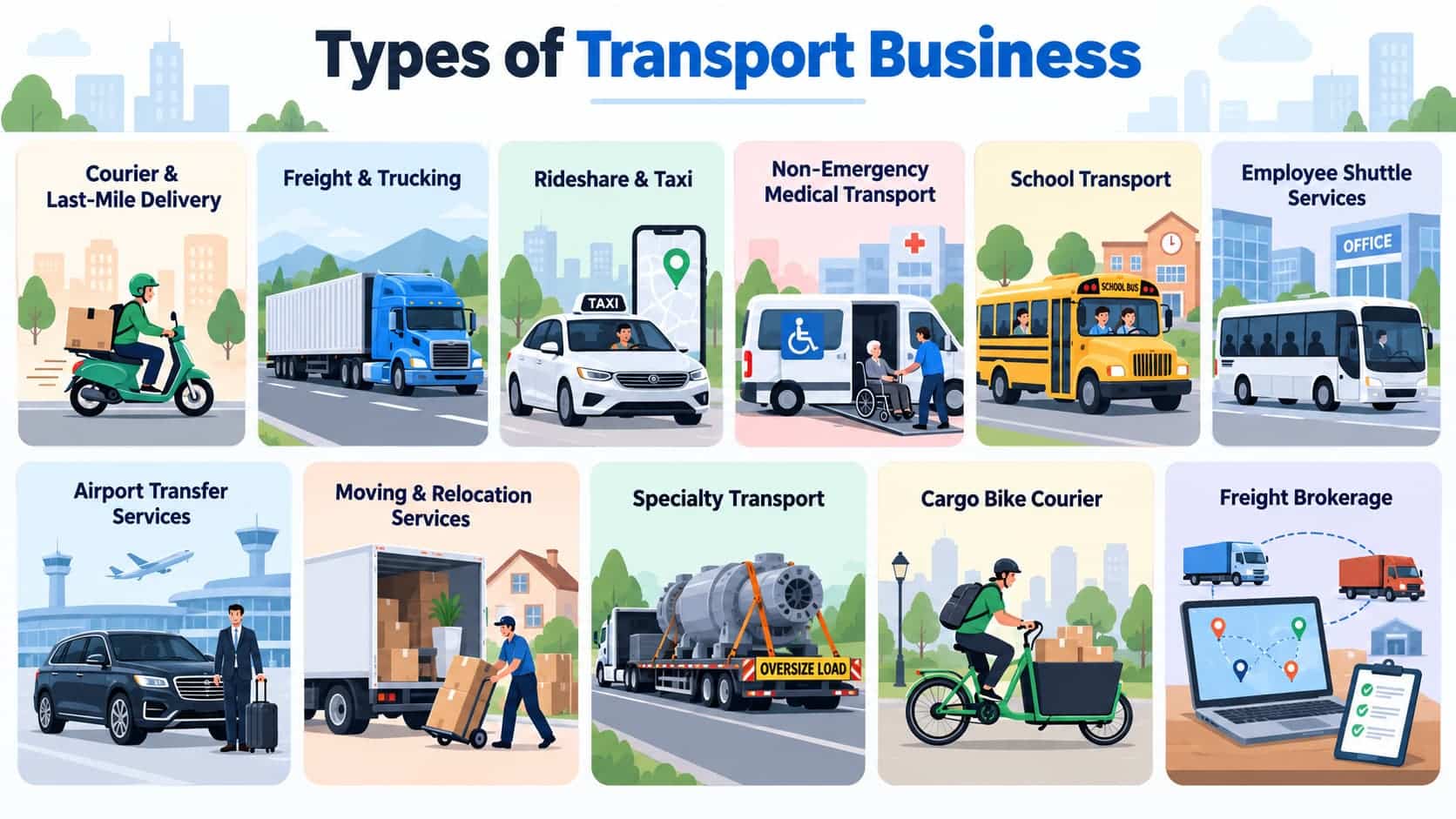
You can launch many types of transport businesses. Each one has different costs, clients, and licensing requirements. The right choice depends on your budget, experience, and local demand. Start with one model. Adding more services later is far easier than managing too many at once from the beginning.
1. Courier and Last-Mile Delivery
Courier services deliver packages for local businesses and platforms. This is one of the lowest-cost transport businesses to start. A car, van, or bike can get you going in days.
A solo courier can start for under $5,000. You compete with platforms like DoorDash and Uber Eats for some jobs. But local B2B contracts pay more and are more predictable. Focus on building repeat clients with small businesses, offices, and medical suppliers.
2. Freight and Trucking
Freight hauling moves large shipments between cities or states. Startup costs are higher here. But demand is steady, and revenue per job is stronger than most other transport models.
A commercial truck can cost $40,000 to $100,000 or more. You need a USDOT number and may need a Commercial Driver’s License (CDL) depending on vehicle weight. Freight hauling suits operators who want high-value contracts and do not mind the higher entry cost.
3. Rideshare and Taxi Services
This model transports passengers on demand through apps or direct bookings. It suits solo operators with a clean driving record and a reliable vehicle. Competition from apps is strong, but demand remains steady year-round.
Direct booking clients are often more loyal than app-based riders. Airport runs, corporate accounts, and regular pick-ups can build a solid income base without platform fees eating into your margins.
4. Non-Emergency Medical Transport (NEMT)
NEMT provides rides for patients traveling to medical and therapy appointments. Demand grows steadily as the U.S. population ages. It earns steady contract income from healthcare providers and government programs.
You will need background check clearance, state-specific permits, and the right vehicle insurance. Some states require vehicle inspections and driver training. The upside is that NEMT operators often secure government contracts, which means consistent monthly revenue.
5. School Transport
School transport runs fixed bus or van routes for students. It offers consistent contract income through the school year. Local school boards and private schools both hire independent operators.
Driver background checks and vehicle safety standards are strict in this niche. But winning a school contract means guaranteed work for the full academic year. That makes cash flow planning much easier.
6. Employee Shuttle Services
Employee shuttles move staff between offices and transit hubs on fixed schedules. Companies pay monthly contracts for this service. It is a strong B2B transport model with reliable repeat income.
Tech parks, factories, and hospitals often need shuttle services for their staff. Target businesses with multiple sites or poor local transit access. A single corporate contract can keep one vehicle fully booked five days a week.
7. Airport Transfer Services
Airport transfers pick up and drop off travelers at airports. This service suits operators near busy terminals. Passengers often book ahead, giving you predictable weekly income and easy route planning.
You can build a loyal repeat clientele from business travelers. Premium vehicles like SUVs and executive cars earn higher rates. Partnering with hotels and travel agencies brings in steady referrals without heavy marketing spend.
8. Moving and Relocation Services
Moving services help homes and offices shift their belongings to a new location fast. You need a van or truck, basic equipment like dollies, and good packing supplies.
Weekends and summer months are peak periods for moving businesses. Adding services like furniture assembly or packing help raises your average job value. Residential and commercial clients both need this service regularly.
9. Specialty Transport
Specialty transport moves oversized, fragile, or high-value items that standard carriers cannot handle. Examples include fine art, medical equipment, and industrial machinery. You can charge premium rates for these loads.
Specialty operators need specific insurance for the items they carry. Some loads require permits from state transport departments. The barrier to entry is higher, but so is the pay per job.
10. Cargo Bike Courier
Cargo bike couriers make fast local deliveries in dense city areas. This is the lowest-cost transport option available. A quality bike and a few local contracts can get this launched fast.
E-bikes are a strong investment in this model. They handle hills and cover more ground without the fuel costs of a van. Restaurants, pharmacies, and offices are the best local targets for this service.
11. Freight Brokerage
Freight brokers connect shippers with carriers without owning trucks. Startup costs are low since you skip vehicle purchases. You do need a freight broker license from the FMCSA to operate legally.
Your income comes from the margin between what shippers pay and what carriers charge. Building a strong carrier network is the key to making this work. Specializing in one load type, such as refrigerated goods or oversized cargo, can help you stand out early on.
How to Start a Transportation Business
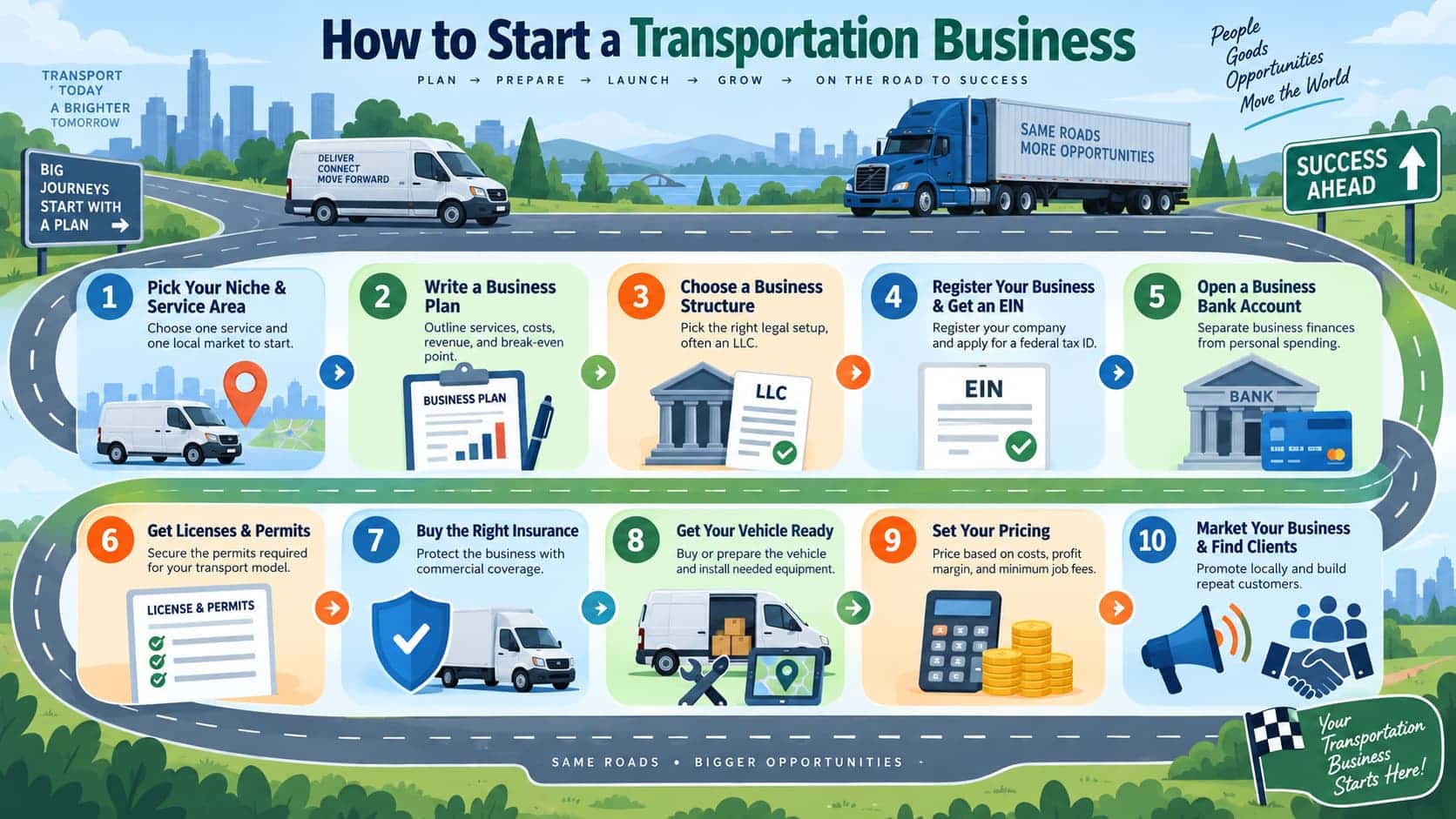
Follow these steps carefully and in order. Each one builds on the last. Skipping ahead causes costly delays that hurt new operators. This section covers picking your niche, writing a solid plan, and registering your company. It also covers getting the right insurance, setting prices, and landing your first clients.
Step 1: Pick Your Niche and Service Area
Choose one transport type and one area to serve. Focus is your biggest early advantage. Trying to cover too much territory or too many services at once spreads your time and money too thin.
Look at what is already available in your area and find the gaps. If medical transport is in short supply or the local courier scene is weak, those are your best starting points.
Step 2: Write a Business Plan
Map out your services, target clients, startup costs, and expected monthly expenses. A good plan does not need to be long. It needs to be specific about your numbers and honest about your risks.
Your plan should include your projected revenue, your break-even point, and your funding sources. Lenders and investors will ask to see this document. Make your financial projections realistic and based on your actual market research.
Step 3: Choose a Business Structure
Most new transport operators register as a Limited Liability Company (LLC). An LLC separates your personal assets from business debts and liabilities. It is also simpler to set up than a corporation.
Sole proprietorships are the simplest option but offer no liability protection. S corporations work well if you have consistent profits and want to reduce self-employment tax. Consult a business attorney to find the right fit for your situation.
Step 4: Register Your Business and Get an EIN
File your business name and structure with your state’s Secretary of State office. Then apply for a free Employer Identification Number (EIN) at IRS.gov. Both steps take under an hour and cost very little.
You also need to register for state and local tax accounts if your state requires it. Once you have your EIN, open a business bank account. Then apply for the licenses your transport model requires.
Step 5: Open a Business Bank Account
Never mix personal and business money. A dedicated business account protects your legal status as an LLC and makes tax preparation far easier. It also helps you build a business credit history for future loans.
Connect your business account to accounting software from day one. This lets you track income and expenses in real time. Knowing exactly what you earn and spend each week is the foundation of a well-run transport operation.
Step 6: Get the Right Licenses and Permits
Requirements vary by state, vehicle type, and service. Some permits take weeks to process. Start the licensing process early so you are not stuck waiting before you can take your first booking.
The section below on licenses covers the specific permits needed by business type. Use that as your checklist. Always confirm current requirements directly with your state’s Department of Transportation and the FMCSA for federal-level rules.
Step 7: Buy the Right Insurance
Commercial auto insurance is required in every state for vehicles used in business. General liability and cargo insurance are also worth having from day one. Costs vary widely by vehicle type, coverage level, and your driving record.
Get quotes from at least three providers before committing. Make sure your policies cover every state or region where you plan to operate. A single uninsured accident can wipe out a new transport business before it gets off the ground.
Step 8: Get Your Vehicle Ready
Buy, lease, or prepare the right vehicle for your niche. Install GPS tracking and any safety equipment required by your state or service type. Keep your maintenance records from day one, as they matter for insurance and resale value.
If you are buying used, have a qualified mechanic inspect the vehicle before purchase. High mileage is less of a concern than the vehicle’s maintenance history. A well-serviced older vehicle beats a cheap one with unknown problems.
Step 9: Set Your Pricing
Use your actual costs to set prices, then add your desired profit margin. Do not copy competitor rates without knowing what their costs are. Their setup may be very different from yours.
Always charge a minimum job fee. Small trips often cost more to complete than they earn once you factor in time, fuel, and wear. Review your rates every six months and add a fuel surcharge when costs rise by a meaningful amount.
Step 10: Market Your Business and Find Clients
Set up a Google Business Profile first. It is free, takes under an hour, and shows up when people search locally for transport services. Then contact local businesses directly. Restaurants, clinics, offices, and warehouses often need regular transport.
Ask your personal network for referrals early on. Offer a small discount on the first job to convert a lead into a long-term client. Repeat business is far cheaper to earn than new business. Focus on reliability and clear communication from the very first booking.
How Much Does It Cost to Start a Transport Business?
Startup costs vary widely depending on your niche, vehicle type, and how many vehicles you start with. A solo bike courier can launch for under $5,000. A single-truck freight operator may need $80,000 to $120,000. Most new solo operators fall somewhere between $12,000 and $30,000 for their first year.
Here is a breakdown of common startup costs:
|
Cost Category |
Low Estimate |
High Estimate |
|---|---|---|
|
Vehicle purchase or lease |
$5,000 |
$100,000+ |
|
Licensing and permits |
$200 |
$5,000 |
|
Insurance (first year) |
$2,000 |
$15,000 |
|
GPS and dispatch software |
$600/year |
$3,600/year |
|
Fuel and maintenance reserve |
$1,000 |
$5,000 |
|
Website and marketing |
$300 |
$2,000 |
|
Working capital buffer |
$3,000 |
$15,000 |
|
Estimated total |
~$12,000 |
$145,000+ |
Pro Tip: Keep at least three months of operating costs in reserve before you open. Running out of cash before clients become regular is the top reason new transport businesses close.
Licenses and Permits You Need for a Transportation Business
Requirements differ based on what you carry, who you carry, and where you operate. Federal rules from the FMCSA apply to interstate operations. State rules govern passenger services, vehicle weight limits, and local permits. Getting this wrong can result in fines, forced shutdowns, and voided insurance coverage.
Here is a breakdown by business type:
|
License or Permit |
Required For |
Where to Apply |
|---|---|---|
|
USDOT Number |
Vehicles over 10,001 lbs used in commerce, or for-hire interstate transport |
FMCSA.dot.gov |
|
MC Number (Operating Authority) |
Hauling freight across state lines for payment |
FMCSA.dot.gov |
|
Commercial Driver’s License (CDL) |
Vehicles over 26,001 lbs or carrying hazardous materials |
Your state’s DMV |
|
Freight Broker License |
Brokering freight shipments without owning the vehicle |
FMCSA.dot.gov |
|
Commercial vehicle registration |
Any vehicle used primarily for business |
Your state’s DMV |
|
State passenger transport license |
Taxis, rideshare, medical, and shuttle services |
Your state’s DOT |
|
Background check clearance |
Required in most passenger and medical transport niches |
State licensing body |
|
Local business license |
Almost all transport businesses in most cities and counties |
City or county clerk |
Always confirm requirements directly with your state’s Department of Transportation. Rules vary by state and change regularly. The SBA’s license and permit tool at SBA.gov is a good starting point for new operators.
Funding Options for Your Transport Business
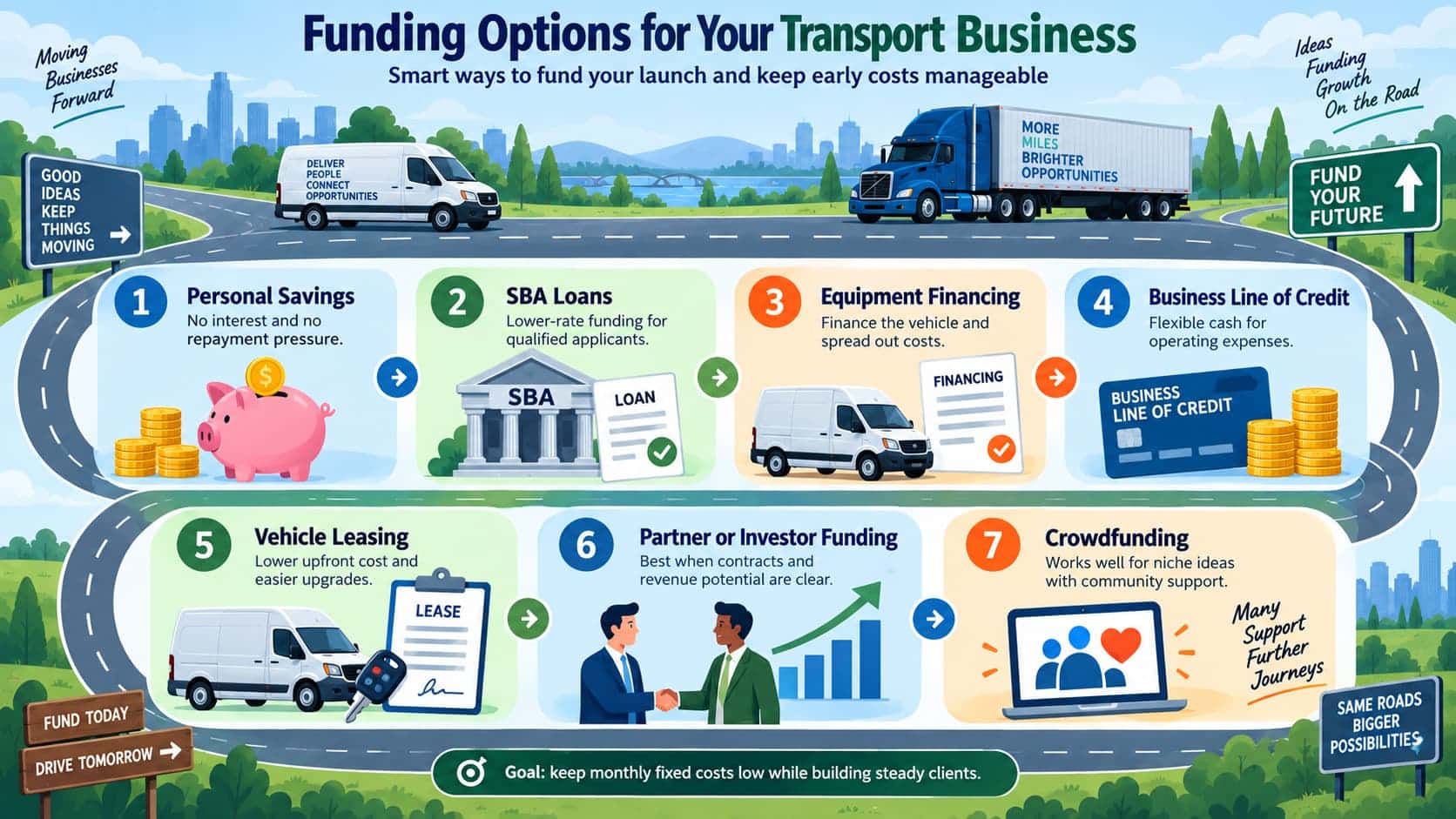
Most new operators use a mix of funding sources rather than relying on a single option. Your goal is to keep fixed monthly costs as low as possible in the early months. High loan repayments before you have steady clients make it hard to survive slow periods.
Here are the main options worth considering:
Personal savings: The simplest option with no repayment pressure and no interest. Works well for low-cost starting models like courier or cargo bike services.
SBA loans: Government-backed loans through approved lenders. They offer lower interest rates than standard business loans for qualifying applicants. The SBA microloan program fits smaller startups under $50,000.
Equipment financing: Lenders finance the vehicle directly, using it as collateral. This spreads the vehicle cost over time and keeps your cash free for day-to-day expenses.
Business line of credit: Flexible borrowing for operating costs. Useful for managing cash flow gaps between client payments. Interest is only charged on what you draw down.
Vehicle leasing: Lower upfront cost than buying outright. Works well for keeping capital free in the early months. You can upgrade vehicles as your business grows.
Partner or investor funding: Works well when you already have local contracts lined up. Investors want to see a clear path to revenue before committing funds.
Crowdfunding: Platforms like Kickstarter or GoFundMe can raise startup funds for new operators. This works best if you have a clear niche with strong community appeal.
How to Price Your Transport Services
Pricing too low is one of the most common errors new operators make. Low rates attract the wrong clients and make it impossible to cover your real costs. Base every price on your actual expenses, not on what you think sounds competitive.
Use this formula to find your minimum rate:
(Fixed monthly costs + Variable costs per trip) ÷ Monthly trips = Break-even rate per trip
Break-even rate + 20% margin = Your minimum charge
Here are the four main pricing models used in transport:
|
Pricing Model |
Best For |
Notes |
|---|---|---|
|
Flat rate |
Short, predictable local trips |
Popular for airport transfers and fixed routes |
|
Per mile |
Freight and long-distance runs |
Trucking companies typically charge $2 to $3 per mile for full truckloads |
|
Hourly rate |
Moving services and charter work |
Add a minimum booking fee to cover short jobs |
|
Monthly contract |
Recurring B2B shuttle or delivery clients |
Offers stable cash flow, ideal for planning |
Always set a minimum job fee. Small trips can cost more to complete than they earn once you factor in time, fuel, and vehicle wear. Review your rates every six months and adjust when your costs change.
Mistakes to Avoid When Starting a Transport Business
These mistakes cost new operators time, money, and clients. Most of them are easy to avoid with a bit of planning before you launch.
-
Underpricing to win work. Low rates attract low-quality clients and kill your margins fast. Set prices based on real costs from day one.
-
Skipping compliance steps. One missed permit or license can result in fines, forced shutdowns, or voided insurance. Do not skip this process.
-
Starting with too many vehicles. More vehicles mean more fixed costs. Grow only when demand proves it. Start lean and scale from real revenue.
-
No written contracts. Always confirm service terms, rates, and payment schedules in writing. A verbal agreement is not enough when disputes arise.
-
Ignoring cash flow. Track money in and money out weekly, not just at month-end. Most transport businesses fail because of cash flow problems, not a lack of clients.
-
No tracking systems. GPS, mileage logs, and invoicing tools are not optional. They protect your business, simplify accounting, and reduce the risk of client disputes.
How to Get Your First Clients for a Transportation Business
You do not need a large advertising budget to land your first jobs. Direct outreach works better than paid ads in the early stages. One good referral from a local business can keep you booked for months.
Set up a Google Business Profile. It is free, quick to set up, and shows up when local people search for transport services in your area. Add your services, hours, and contact information.
Contact local businesses directly. Clinics, restaurants, offices, and warehouses often need regular transport. Send a short, direct message explaining what you do and what it costs. Follow up twice if you do not hear back.
List on relevant directories. Thumbtack, Yelp, and your local chamber of commerce are solid starting points. Many clients find transport providers through these platforms before searching Google.
Ask your network for referrals. People you already know can refer you to your first paying client faster than any advertisement. Be direct and tell them exactly what kind of work you are looking for.
Offer a first-job rate. A small discount on the first booking often converts a warm lead into a long-term account. Frame it as a trial job, not a discount, to set the right tone from the start.
Follow up consistently. Most clients need two or three contacts before they commit. Set a reminder and follow up. Consistent follow-up is the single most underused client-winning tool for new operators.
Frequently Asked Questions
Is a transport business profitable?
Yes. Net margins in transport typically run between 5% and 15%. Profitability depends on your niche, how well you control costs, and how efficiently you manage routes and scheduling.
What is the most profitable transport business to start?
Freight hauling and NEMT tend to generate the highest margins. Freight earns more per trip, while NEMT offers steady contract income with lower vehicle costs.
How much money do you need to start a transportation business?
Startup costs range from under $5,000 for a bike courier to over $120,000 for a freight operation. Most solo operators launch with $12,000 to $30,000.
Which type of transport is the safest?
Air travel is statistically the safest mode of transport per mile traveled. Rail comes second. Road transport carries the highest accident risk per trip.
What is the fastest mode of transport?
Air travel is the fastest mode of commercial transport. Passenger jets cruise at around 575 miles per hour. Supersonic aircraft can exceed 1,300 miles per hour.
Which is the slowest type of transport?
Sea freight is the slowest common mode of commercial transport. A cargo ship typically travels at 10 to 15 knots per hour. It is used for large, non-urgent shipments.
What is the oldest form of transport?
Walking is the oldest form of human transport. After that, animal riding developed thousands of years ago. Wheeled vehicles appeared around 3500 BC in Mesopotamia.
Starting Your Transport Business
Starting a transport business takes planning, but the steps are clear and manageable. Pick one niche, get your legal setup in order, and price your services based on real costs. Then focus on landing your first reliable clients before you think about expanding.
The transport businesses that last are not always the biggest ones. They are the ones that show up on time, charge fair rates, and keep costs under control from day one.
You now have the steps, the real cost data, and the pricing tips you need to begin. Work through them carefully and take it one clear stage at a time. A well-run transport business with just one vehicle can generate solid, steady income. Start small, stay organized, and grow steadily from there.