
Building a startup means making hundreds of decisions before lunch. One of the most consequential? Whether to piece together generic tools or invest in custom software built around your specific business model.
Off-the-shelf software gets you moving fast. But it also forces your team into someone else’s workflow, limits your ability to differentiate, and creates hidden costs when you outgrow it. Custom software development flips that equation: the technology works for you, not the other way around.
This guide breaks down what custom software development looks like for startups at every stage, what it costs, where founders get it wrong, and how to make smart decisions about building vs. buying.
What Is Custom Software Development?
Custom software development is the process of designing, building, and maintaining applications or platforms that are purpose-built for a specific business.
Instead of adapting your operations to fit a pre-packaged tool, custom software molds itself to your workflows, users, and growth trajectory.
The core difference comes down to control. With ready-made solutions, the vendor dictates the feature roadmap, the integration options, and the update schedule. With custom development, those decisions sit with you.
For startups, this distinction carries real weight. Your product, your user experience, and your operational efficiency all depend on technology that can move as fast as you do.
When Does Custom Software Make Sense for a Startup?
Not every startup needs custom software from day one. The timing matters as much as the decision itself. Three moments tend to push founders toward custom builds:
Launching an MVP to validate market fit: You need something lean, focused, and built to collect real user feedback, not a Frankenstein stack of SaaS tools duct-taped together.
Scaling operations as demand grows: The tools that worked for 100 users start breaking at 10,000. Custom software lets you optimize performance and architecture without migrating to an entirely new platform.
Building proprietary features that define your competitive moat: If your product is your differentiator, generic tools will never deliver the experience your users expect. A fintech startup handling sensitive transactions or a healthtech company navigating HIPAA compliance needs software that addresses those realities from the architecture level up.
Custom Software vs. Off-the-Shelf: A Side-by-Side Look
The right call depends on which parts of your stack give you a competitive edge and which are commodity functions.
| Factor | Custom Software | Off-the-Shelf |
|---|---|---|
| Upfront Cost | Higher initial investment | Lower entry price |
| Long-Term Cost | Reduces over time; no recurring license fees for features you don’t use | Subscription costs compound; add-ons and scaling tiers add up |
| Customization | Built to your exact specifications | Limited to what the vendor offers |
| Time to Launch | Weeks to months, depending on the scope | Immediate to days |
| Scalability | Grows with your business on your terms | Capped by vendor infrastructure and pricing tiers |
| Ownership | You own the code, the data, and the IP | Licensed; vendor-dependent |
| Integration | Connects to your existing stack without workarounds | May require middleware or manual processes |
| Maintenance | Requires internal team or contracted partner | Vendor handles updates |
| Security | Full control over security architecture | Shared responsibility with vendor |
The practical rule: Custom-build what makes you unique. Use off-the-shelf for everything else: accounting, email, project management, and other commoditized functions.
Why Startups Choose Custom Development
1. Competitive Differentiation
When your product IS the technology, generic tools put a ceiling on what you can offer. Custom software lets you build features that don’t exist anywhere else in the market, the kind of functionality that makes users choose you over alternatives.
2. Faster Iteration Cycles
You don’t wait for a vendor to prioritize the feature your users have been requesting for six months. Your team ships updates on your timeline, based on direct user feedback.
3. Tighter Integration Across Systems
Custom solutions plug directly into your existing tools and data sources. That means fewer data silos, less manual entry, and operations that actually talk to each other.
A logistics startup, for example, can build a system that pulls GPS data, inventory levels, and delivery routing into one unified view, something no off-the-shelf tool would handle out of the box.
4. Full Ownership of IP and Data
Every line of code belongs to you. Every data point stays under your control. That ownership becomes a tangible asset when you’re raising funding, negotiating partnerships, or preparing for acquisition.
5. Scalability Without Painful Migrations
Need to handle 10x more users next quarter? Custom architecture can be optimized for exactly that scenario. You’re not locked into a vendor’s capacity limits or forced into an expensive enterprise tier just because your user base grew.
6. Security and Compliance on Your Terms
For startups in regulated industries like fintech, healthtech, edtech, and insurance, security and compliance aren’t afterthoughts.
Custom software lets you bake encryption, access controls, multi-factor authentication, and regulatory requirements into the foundation rather than bolting them on later.
Types of Custom Software Startups Commonly Built
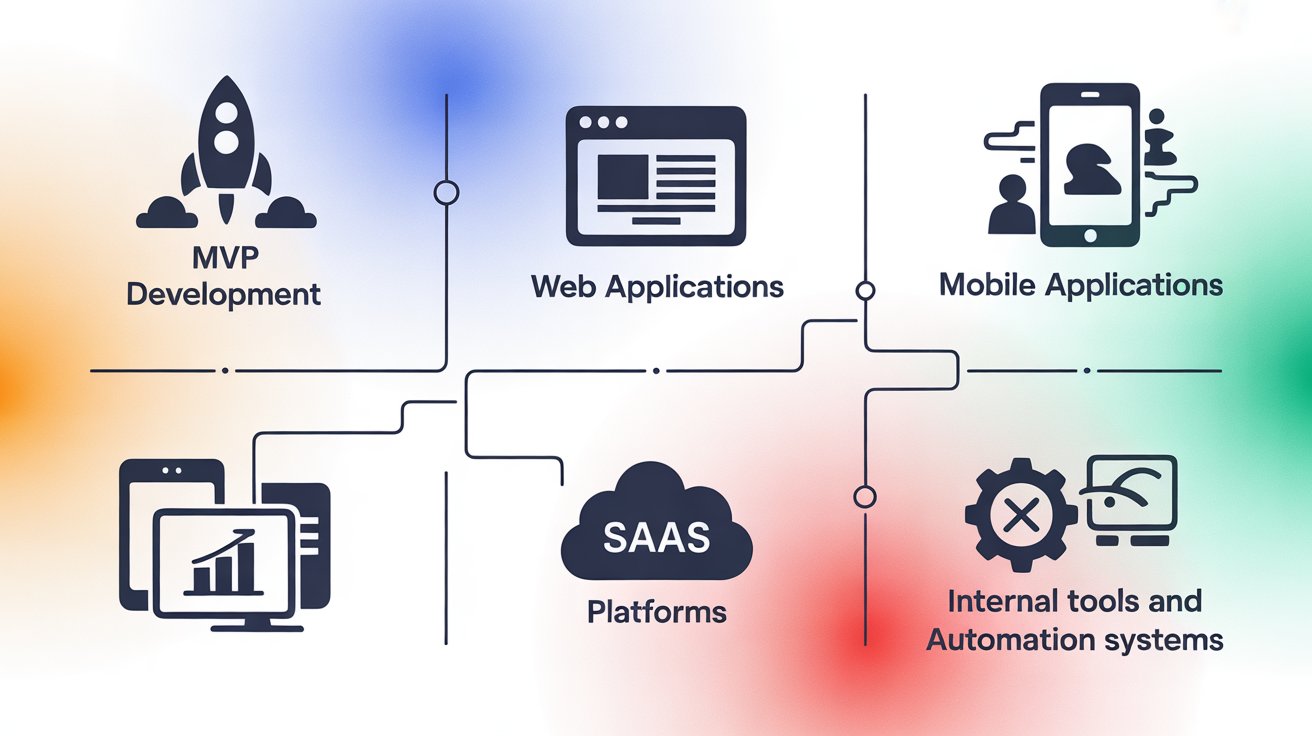
The kind of software you need depends on your business model, your audience, and where you are in your growth journey.
1. Minimum Viable Products (MVPs): Stripped-down versions of your product built to test a hypothesis with real users. The goal is speed and learning, not perfection. A well-scoped MVP typically focuses on one core workflow and gathers data that informs every subsequent decision.
2. Web Applications: Browser-based platforms powering everything from customer dashboards to internal admin panels. These are the workhorses behind most SaaS startups, B2B tools, and marketplace platforms.
3. Mobile Applications: Native or cross-platform apps that reach users on iOS and Android. Critical for consumer-facing products where the phone is the primary touchpoint.
4. SaaS Platforms: Subscription-based software sold to other businesses. The architecture here needs to support multi-tenancy, usage-based billing, role-based access, and reliable uptime from day one.
5. Internal Tools and Automation: Custom dashboards, reporting systems, and workflow automation that help small teams punch above their weight. These often deliver the highest ROI per dollar spent because they eliminate repetitive manual work across the entire organization.
6. Industry-Specific Applications: Healthcare apps that handle patient data under HIPAA. Fintech platforms that manage transactions under PCI-DSS. Edtech tools that track learning outcomes. Each vertical has its own regulatory, security, and UX requirements that generic software simply cannot address.
The Development Process: From Concept to Launch
1. Discovery and Requirements Analysis
Every project starts here. The goal is to get absolute clarity on the problem you’re solving, who you’re solving it for, and the constraints around budget, timeline, and technology.
Good development teams spend significant time in discovery because fixing a misunderstanding at this stage costs a fraction of what it costs after code has been written.
This phase should produce a clear project scope, defined user personas, technical requirements documentation, and a prioritized feature list.
2. Market Validation
Before writing a single line of code, validate that your concept addresses a real need. Talk to potential users. Run surveys. Study your competitors to see what they’re doing well and where they’re falling short.
Define your unique value proposition and make sure the market actually wants it.
Skipping this step is one of the most expensive mistakes a startup can make.
3. Product Strategy and Technical Planning
With validated requirements in hand, map out the architecture. Choose your technology stack based on long-term needs, not just what’s trending. Plan the development in phases: what ships in the MVP, what comes in version two, and what lives on the long-term roadmap.
Common technology stacks for startups in 2026 include Python with Django or FastAPI for backend development (especially strong for AI/ML), Node.js with TypeScript for full-stack JavaScript, and React with Next.js for frontend interfaces.
For mobile, React Native and Flutter dominate cross-platform development.
The stack you pick affects hiring, performance, maintenance costs, and your ability to pivot. Get this decision right.
4. UI/UX Design
First impressions carry enormous weight, especially for consumer-facing products. Design should start with user research to understand behaviors, preferences, and pain points before moving into wireframes, prototypes, and usability testing.
Even simple tests with a handful of users can surface the majority of interface problems before full development begins. Build those feedback loops early and revisit them often.
5. Development and Testing
This is where the product takes shape. Backend work focuses on database architecture, business logic, APIs, and security. Frontend development brings the interface to life with responsive, intuitive interactions.
Modern teams work in iterative sprints, building, testing, and refining in short cycles rather than spending months on a single big release.
Automated testing frameworks should be part of the setup from day one; they become invaluable as the codebase grows and new features need to ship without breaking existing functionality.
6. Deployment, Monitoring, and Maintenance
Launching is not the finish line. Post-deployment involves performance monitoring, bug fixes, user feedback collection, and continuous improvement.
Cloud-based infrastructure, where you pay for what you use and scale resources up or down based on actual demand, has become the default approach for startups.
Plan for ongoing maintenance from the start. The best development partners build systems with long-term maintainability in mind, using clean architecture, thorough documentation, and modular code that’s straightforward to update.
How Much Does Custom Software Development Cost?
Cost varies widely depending on scope, complexity, and team structure. Here are general ranges:
MVP development: $25,000–$75,000. A focused product with core features, minimal design, and a clear testing plan.
Mid-complexity products: $75,000–$250,000. Multi-feature platforms with integrations, user roles, and polished interfaces.
Full-scale enterprise products: $250,000–$500,000+. Complex architectures, compliance requirements, third-party integrations, and robust security layers.
Budget for the full lifecycle, not just the initial build. Maintenance, updates, infrastructure costs, and scaling should all factor into your financial planning. A common mistake is allocating the entire budget to launch and leaving nothing for the months that follow.
Outsourcing vs. In-House: How to Staff Your Build
Startups rarely have the luxury of a full in-house engineering team from day one. Three common models exist:
In-house development gives you maximum control and cultural alignment but requires significant upfront investment in recruiting, salaries, and infrastructure. Best suited for startups where technology is the core product and long-term technical ownership matters.
Outsourcing to a development partner lets you access specialized expertise without the overhead of full-time hires. Look for partners with proven startup experience, because building for early-stage companies demands a different skill set than enterprise software development.
Hybrid models combine a lean in-house team (often a CTO or lead developer) with an outsourced team that handles execution. This balances strategic control with development speed.
Many successful companies, including Slack, Skype, and Alibaba, outsourced parts of their early development. The key is choosing the right partner, not avoiding outsourcing entirely.
How to Choose the Right Development Partner
Look for startup experience, not just technical credentials. A team that has built and launched MVPs understands trade-offs that enterprise-focused firms don’t: how to scope aggressively, where to cut corners without creating technical debt, and how to ship fast without sacrificing quality.
Evaluate their portfolio with a critical eye. Ask about projects similar to yours. Request case studies with measurable outcomes, not just screenshots.
Test their communication early. Transparent processes, regular updates, and the ability to explain technical decisions in plain language separate good partners from great ones. Pay attention to how responsive they are during the evaluation phase, as it’s a strong predictor of how they’ll behave during the project.
Understand engagement models. Fixed-price contracts work for well-defined scopes. Time-and-materials models offer more flexibility for evolving requirements. Dedicated teams suit longer engagements where you need consistent velocity.
Confirm post-launch support. The best partners stay involved after deployment, handling maintenance, monitoring, and iteration. Ask specifically about their support model before signing anything.
Common Mistakes That Burn Startup Budgets
Overbuilding before validating demand. Adding features nobody asked for is the fastest way to run out of money. Ship the smallest version that tests your hypothesis, then expand based on data.
Ignoring user feedback during development. Building in a vacuum produces products that miss the mark. Incorporate feedback loops from the first sprint, not after launch.
Choosing technology based on hype instead of fit. The newest framework isn’t always the right choice. Evaluate your stack based on your team’s expertise, your product’s requirements, and your ability to hire developers who can maintain it.
Underestimating timelines and budgets. Software projects almost always take longer and cost more than initial estimates suggest. Build buffer into both your timeline and your budget. A 20–30% contingency is standard practice for experienced teams.
Neglecting technical debt. Shortcuts made to ship faster accumulate over time. If you don’t plan for regular refactoring and code cleanup, those shortcuts become expensive roadblocks when it’s time to scale.
Skipping the discovery phase. Jumping straight into development without proper requirements analysis leads to rework, scope changes, and missed deadlines. The time invested in discovery pays for itself many times over.
Trends Shaping Custom Software Development in 2026
AI integration is no longer optional. Startups are expected to build with intelligence from the start, whether that’s AI-powered search, recommendation engines, automated customer support, or predictive analytics. Development partners who can’t implement AI/ML capabilities are offering outdated services.
Low-code and no-code platforms are handling commodity functions. Internal dashboards, simple CRUD applications, and basic workflow automation are increasingly built on low-code platforms, freeing up custom development budgets for the features that actually require bespoke engineering.
Cloud-native architecture is the baseline. Microservices, containerization, and serverless functions have moved from cutting-edge to expected. Startups launching monolithic applications in 2026 are building legacy systems from day one.
Privacy-by-design is a regulatory requirement, not a feature. Data privacy legislation continues to tighten globally. Custom software must account for GDPR, CCPA, and industry-specific regulations at the architectural level.
Final Thoughts
Custom software development is not a luxury reserved for well-funded startups. It’s a strategic decision that determines how fast you can move, how well you can differentiate, and how effectively you can scale.
The founders who get this right share a few habits: they validate before they build, they scope ruthlessly, they choose partners based on evidence rather than sales pitches, and they plan for the full lifecycle, not just launch day.
Off-the-shelf tools have their place. Use them where they make sense. But for the technology that defines your product, your user experience, and your competitive position, build it yourself, build it right, and build it to last.








One Response