
Starting a business is hard.
Most new companies fail within their first few years. They run out of money. They make costly mistakes.
They struggle to find customers or investors. The odds are stacked against first-time entrepreneurs.
But what if you didn’t have to figure everything out alone?
Business incubators exist to change those odds. These programs connect startups with mentors, funding sources, and resources that can turn struggling ideas into profitable companies.
They’ve helped thousands of entrepreneurs avoid common pitfalls and build businesses that last.
This guide shows you everything about business incubators. You’ll learn the different types available, why joining one matters, and what top programs offer.
What is a Business Incubator?
A business incubator is a program that helps early-stage startups grow and succeed.
Think of it as a training ground for new companies. Incubators provide workspace, mentorship, and access to resources that most entrepreneurs can’t afford on their own.
The goal is simple: help startups survive their critical early years and build a strong foundation for long-term success.
Here’s what most business incubators offer:
- Physical workspace where you can work without paying high rent. Many incubators provide shared office space, meeting rooms, and equipment.
- Expert mentorship from successful business owners and industry professionals. These mentors guide you through challenges and help you avoid common mistakes.
- Access to investors who are actively looking for promising startups to fund. Incubators connect you with angel investors, venture capitalists, and other funding sources.
- Business training through workshops and seminars. You’ll learn essential skills like marketing, finance, legal compliance, and operations management.
- Peer support from other entrepreneurs in the program. You can share experiences, solve problems together, and build lasting relationships.
Most incubation programs last one to three years. During this time, your startup receives ongoing support as it grows.
Many business incubators don’t require equity in your company. Non-profit and university programs often charge low fees or are entirely free.
Unlike coworking spaces that provide desks, incubators actively invest time, expertise, and resources into making your business successful.
Now that you know what incubators are, let’s explore how they actually operate.
How Do Business Incubators Work?
Business incubators follow a structured process to help startups succeed.
First, you apply to join the program. If accepted, you enter an incubation period where you receive multiple forms of support.
Most programs have clear milestones you need to reach. When your business becomes stable enough to operate independently, you graduate from the program.
Here’s exactly what you get when you join a business incubator:
| Type of Support | What You Get | Key Benefits |
|---|---|---|
| Mentorship & Guidance | • One-on-one sessions with experienced entrepreneurs • Strategic business planning • Product and marketing coaching |
• Avoid costly mistakes • Get expert answers fast • Make smarter decisions |
| Networking Opportunities | • Access to potential investors • Regular networking events • Connections with industry leaders |
• Find funding faster • Meet potential clients • Build valuable relationships |
| Resources & Infrastructure | • Professional office space • High-speed internet and equipment • Legal and accounting services |
• Save on overhead costs • Access professional facilities • Get expert help at low rates |
| Funding Support | • Introductions to investors • Demo day presentations • Pitch deck preparation help |
• Easier access to capital • Better fundraising preparation • Higher funding success rate |
With so many support options available, you might wonder which type of incubator is right for you.
Different Types Of Business Incubators
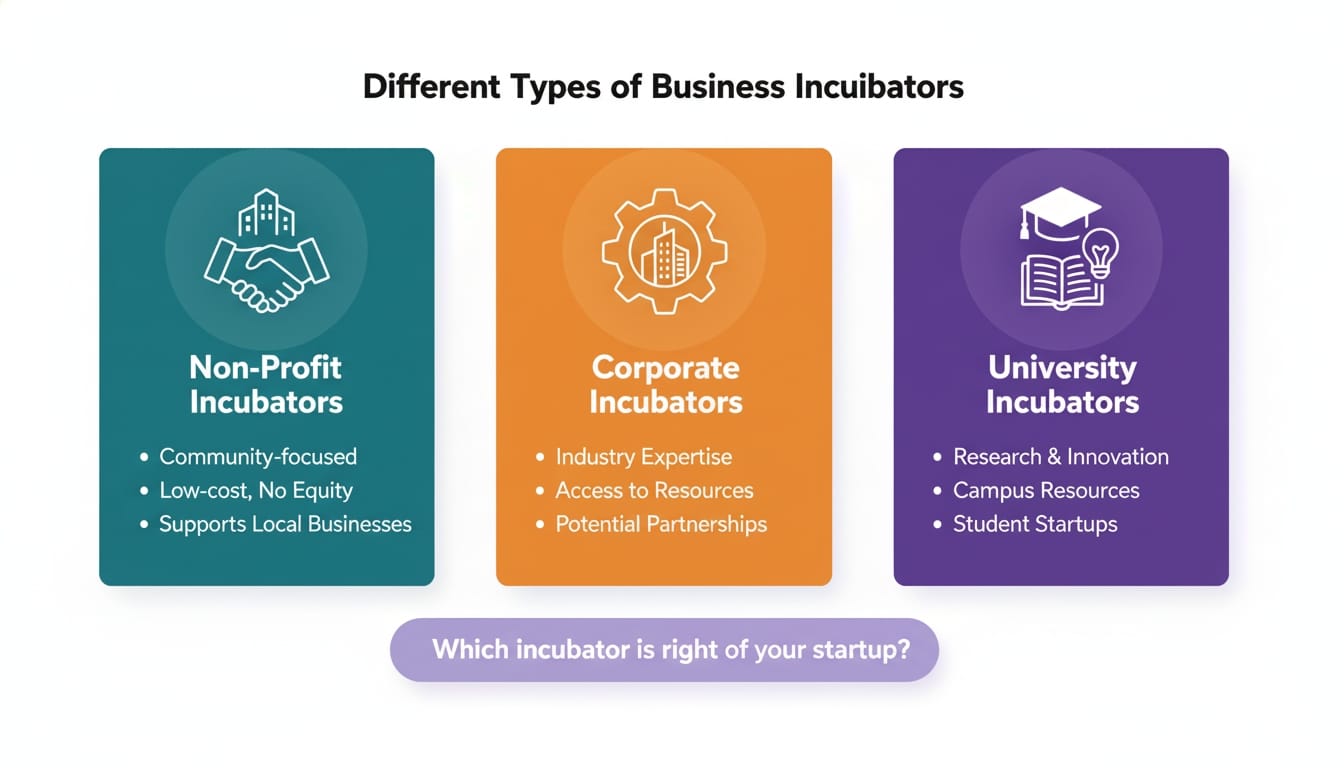
Not all business incubators operate the same way. Different types serve different purposes. Some focus on specific industries. Others target certain stages of business development.
Understanding these differences helps you choose the right program for your startup. Here are the three main types:
1. Non-Profit Incubators
Non-profit incubators focus on economic development rather than financial returns.
Government grants, donations, or community organizations often fund these programs. Their mission is to create jobs and strengthen local economies.
What makes them different?
They stand out because of their community-focused approach:
- Usually free or very low cost
- Don’t take equity in your company
- Support underserved communities and entrepreneurs
- Focus on long-term local impact
Non-profit incubators accept a wider range of businesses. They’re less concerned about rapid growth and more interested in building stable companies that create jobs.
Best for: First-time entrepreneurs with limited funds who want to keep full ownership of their business.
2. Corporate Incubators
Corporate incubators are run by large companies looking for new ideas and technologies.
These programs help corporations stay connected to innovation.
They partner with startups that align with their industry or strategic goals.
What makes them different?
Here’s what sets them apart from other programs:
- Industry-specific focus
- Access to corporate resources and expertise
- Potential partnerships or acquisition opportunities
- Higher expectations for performance
Corporate incubators provide deep industry knowledge. You’ll work closely with experts from the parent company. Some programs lead to investment or partnership deals.
Best for: Startups working in a specific industry who want access to major players and potential buyers.
3. University Incubators
University incubators support startups founded by students, alums, or faculty members.
These programs leverage academic research and campus resources. They help turn research projects and student ideas into real businesses.
What makes them different?
Their unique advantage lies in academic connections:
- Connected to research facilities and labs
- Access to student talent and interns
- Focus on technology and innovation
- Often tied to specific academic fields
University incubators excel at supporting tech-based startups. You can use campus labs, partner with researchers, and hire talented students.
Best for: Technology startups, research-based businesses, and student entrepreneurs who need specialized equipment or academic expertise.
Each type offers something unique, but why join any incubator at all?
Why Join A Business Incubator?
Joining a business incubator gives your startup a significant advantage.
The numbers speak for themselves. Studies show that 87% of incubated businesses survive past five years. Compare that to just 44% of the companies that go it alone.
Here are three primary reasons to join a business incubator:
| Benefit | What It Means | How It Helps |
|---|---|---|
| Reduced Risk | Mentors help you avoid costly mistakes and test ideas safely | • Lower startup costs with free resources • Learn from experienced entrepreneurs |
| Faster Growth | Access to connections and proven strategies speeds up progress | • Skip months of trial and error • Get introduced to investors and customers |
| Credibility | Being part of a reputable program validates your business | • Investors take you seriously • Customers trust you more |
Business incubators give you the support, connections, and resources that dramatically increase your chances of success.They turn risky ventures into calculated bets.
Pro Tip: Research shows startups that actively engage with mentors and attend all program events see 3x faster revenue growth than those who just use the office space. Don’t just join an incubator, participate fully in everything it offers.
You’re convinced that incubators work, but here’s the real question: How do you identify the truly exceptional programs that will actually help your startup thrive?
Key Features Of Successful Incubators

Not every business incubator will help your startup succeed.
Some programs look good on paper but fail to deliver real value. Others have everything you need to grow fast.
The difference lies in specific features that separate top-tier incubators from mediocre ones.
Look for these four essential qualities:
1. Proven Track Record
Check how many companies have graduated from the program and where they are now. Ask about survival rates, funding raised, and companies acquired.
Numbers don’t lie if an incubator can’t show concrete success stories,
What to look for:
- High graduation rates and alumni survival beyond five years
- Success stories of companies that raised funding or got acquired
- Concrete data on revenue growth and job creation
- Alums who credit the program for their achievements
Numbers don’t lie. If an incubator can’t show you concrete success stories, that’s a red flag.
2. Experienced Mentors
The best programs attract successful entrepreneurs who’ve built and sold companies.
These mentors offer more than advice; they share battle-tested strategies from their own experiences.
Quality beats quantity every time.
What makes mentors valuable:
- They’ve built and sold their own companies
- They offer battle-tested strategies from real experience
- They specialize in your industry or business model
- They commit regular time to work with you
Quality beats quantity. Five experienced mentors who’ve raised millions beat twenty mentors with no real startup experience.
3. Strong Network
Top incubators have relationships with investors, corporate partners, and industry leaders.
They can make introductions that would take you years to arrange on your own.
The network extends beyond the current cohort; alums often become customers, partners, or investors.
What a strong network includes:
- Relationships with active investors and venture capitalists
- Corporate partners who can become customers
- An alumni network that supports new startups
- Regular events where you meet industry leaders
The network extends beyond the current cohort. Alums often become customers, partners, or investors for newer startups.
4. Programs Built For Your Needs
The best incubators tailor their support to your startup’s stage, industry, and specific challenges.
They assess what you need and adjust their resources accordingly. Flexibility matters as your needs change over time.
What customization looks like:
- Support adjusted based on your industry and stage
- Different tracks for different types of businesses
- Extra help in areas where you need it most
- Flexibility to change as your needs shift
Great incubators assess what you need and adjust their resources accordingly.
You’ve found the perfect incubator with all these features. Now comes the hard part: getting accepted into a competitive program.
How To Get Accepted Into A Business Incubator?

Getting into a business incubator is competitive.
Most programs receive hundreds of applications but only accept 10 to 20 startups per year. The selection process is challenging because incubators want companies that will succeed and enhance their reputation.
But don’t let the competition discourage you. If you prepare correctly, you can stand out from other applicants.
Here’s what successful applicants do:
1. A Solid Business Plan
Your business plan shows you’ve thought through every aspect of your startup.
Incubators want to see that you know your market, competitors, and financial projections.
A solid plan proves you’re serious and prepared. It doesn’t need to be 50 pages long, but it must cover the essentials clearly.
Your plan should include:
- A clear problem statement and your solution
- Target market research and size
- Revenue model and financial projections
- Competitor analysis and your competitive advantage
Focus on facts over hype. Show real data about your market. Explain why customers will pay for your product. Be realistic about the challenges you’ll face.
2. A Compelling Pitch
Your pitch is your chance to make a memorable first impression.
You typically get 5 to 10 minutes to present your startup to the selection committee. This short window determines whether you move forward or get rejected.
Practice until you can deliver your pitch confidently and answer tough questions.
Your pitch must communicate:
- The problem you’re solving and why it matters
- Your unique solution and how it works
- Your team’s ability to execute the plan
- Why do you need this specific incubator
Tell a story that connects emotionally. Use simple language that anyone can follow. Skip jargon and technical terms that confuse people. End with a clear ask and next steps.
3. Readiness to Learn
Incubators want coachable entrepreneurs who listen and adapt.
Even if you have experience, show that you’re open to feedback and willing to change course when needed.
The best startups pivot based on what they learn. Programs look for founders with growth mindsets, not know-it-alls who resist advice.
Demonstrate your readiness by:
- Asking thoughtful questions during interviews
- Showing how you’ve adapted based on customer feedback
- Being honest about what you don’t know
- Expressing enthusiasm for mentorship and learning
Confidence is good. Arrogance kills your application. Show that you value the expertise the incubator offers.
You now have everything you need to find, evaluate, and join the right business incubator for your startup.
Conclusion
Business incubators give startups the support they need to grow. You’ve seen the key benefits they offer: reduced risk, faster growth, and instant credibility.
The right incubator provides mentorship, workspace, funding connections, and a network that would take years to build alone.
Whether you choose non-profit, corporate, or university programs depends on your goals and industry. Your next step is simple. Research incubators that match your startup’s needs.
Attend their events. Connect alumni. Then craft an application that shows your potential. Ready to give your startup the best chance at success?
Start your incubator search today!