
Running a business is rewarding. It can also grind you down. You check your bank balance at midnight. You lie awake before payroll. You second-guess every hire.
This blog breaks down the main reasons why entrepreneurs experience daily stress and shows you practical ways to manage each one.
7 Reasons Entrepreneurs Experience Daily Stress
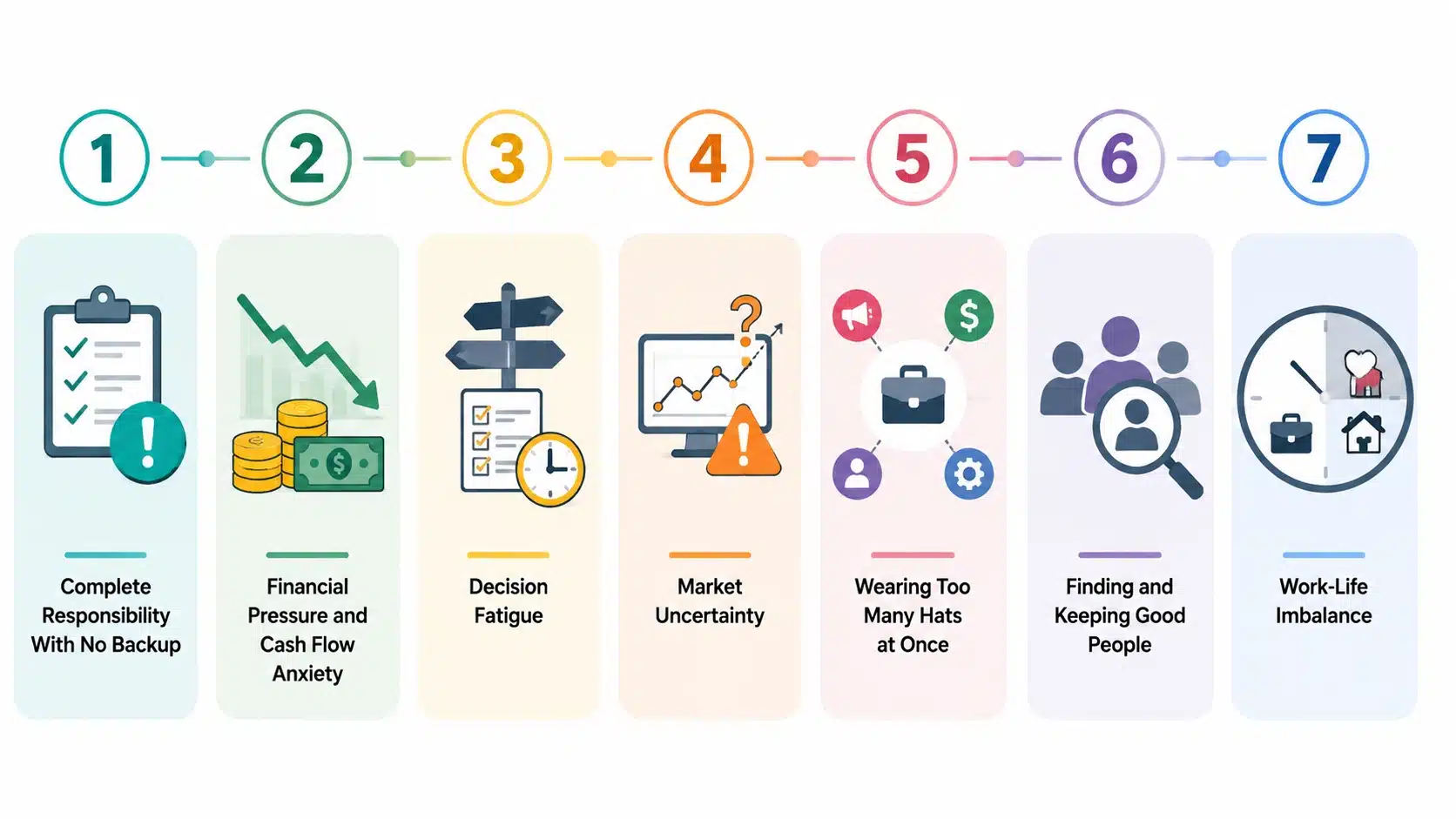
The main reason entrepreneurs experience daily stress is total accountability.
Unlike an employee who shares responsibility with a team, you own everything. Success, failure, payroll, product quality, customer satisfaction. All of it falls on you.
Add ongoing uncertainty about revenue, markets, and team performance, and the stress compounds fast. Below are the seven most common sources of that stress.
1. Complete Responsibility With No Backup
When you own a business, the buck stops with you. No manager to escalate problems to. No HR department to handle conflicts. No finance team to rescue a cash crunch.
Every hiring decision, every pricing call, every delayed shipment. They all land on your desk.
Your family’s financial security and your employees’ livelihoods depend on the calls you make. That weight does not switch off when you leave the office.
2. Financial Pressure and Cash Flow Anxiety
Financial worry is one of the most consistent sources of stress for business owners. Starting or growing a company takes money. Payroll, rent, inventory, software. The costs do not stop.
The deeper fear is not just “do I have enough money now?” It is “what if I run out?” Famous Entrepreneurs often use personal savings to fund the business. That raises the personal stakes even higher.
- Cash flow gaps between invoices and payments
- Slow sales months that still carry full expenses
- Funding rounds that fall through at the last minute
- Personal savings tied up in the business
Knowing your numbers weekly (not monthly) can reduce this anxiety. A three-month cash reserve also removes the panic from one bad month.
3. Decision Fatigue
Entrepreneurs make hundreds of decisions each day. Some are small. Some are not. Strategy, hiring, pricing, marketing spend, product roadmap. The list does not stop.
This constant choosing drains mental energy. By afternoon, your ability to think clearly drops. Bad decisions often happen late in the day, not because you are careless, but because your brain is simply worn out.
A few ways to reduce decision fatigue:
- Handle big decisions in the morning when your mind is fresh
- Build routines that remove repeat choices (meals, schedule blocks)
- Delegate smaller decisions to trusted team members
- Set a time limit on decisions to stop overthinking
4. Market Uncertainty
Business does not follow a predictable script. A loyal customer leaves without warning. A competitor launches a cheaper product, or cyber risks like weak business network security create new challenges. An economic shift cuts your market in half. Consumer preferences shift faster than you can keep up.
This unpredictability puts your nervous system on high alert. You scan for threats constantly. You plan for contingencies you hope never arrive. The ground never feels stable.
Entrepreneurs who track market signals weekly, rather than reacting to surprises, tend to handle this stress better. Building a flexible budget also helps absorb sudden changes.
5. Wearing Too Many Hats at Once
Most founders start as the CEO, the accountant, the marketer, the customer service rep, and the delivery person. There simply aren’t enough hours to do it all well.
Time stress comes from two places. First, there are too many tasks. Second, it is hard to know which ones deserve your focus right now versus next week.
Many entrepreneurs feel productive while buried in low-value tasks. In reality, they are pulled away from the work that actually grows the business.
Delegation is not a weakness. It is how you get your time back. Start by listing every task you handle in a week. Mark the ones only you can do. Find someone (or a tool) to handle the rest.
6. Finding and Keeping Good People
Hiring is time-consuming and expensive. One wrong hire can damage customer relationships, team culture, and your own stress levels for months.
Once you find great people, keeping them is another challenge. High turnover disrupts operations and forces you back into recruiting mode when you should be building.
The fear of letting go is another layer here. Many founders become a bottleneck because they cannot fully trust others to do the work. This creates stress on both sides.
7. Work-Life Imbalance
Entrepreneurship bleeds into personal time. You check emails during dinner. You take calls on weekends. You feel guilty stepping away, even for a few hours.
Your body needs rest. Your relationships need your presence. When work takes over every space in your life, physical and mental health both take the hit.
The “I’ll slow down once things stabilize” plan rarely works. Stability tends to bring new problems, not fewer ones. Protecting personal time has to be a deliberate choice, not something that happens when the business lets you.
How Stress Affects Your Business Performance
Prolonged stress does not just feel bad. It changes how you think and decide. Under chronic stress, the quality of decisions drops. You take shortcuts. You avoid hard conversations. You miss signals you would normally catch.
Physical symptoms also show up over time:
- Disrupted sleep and constant fatigue
- Headaches and muscle tension
- Digestive issues or changes in appetite
- Irritability and a short fuse with your team
- Difficulty staying focused for long periods
The pattern becomes a loop. More stress leads to worse decisions. Worse decisions create new problems. New problems add more stress.
Your immune system weakens under this pressure. You get sick more often, and recovery takes longer. The drive that pushes you to work harder also reduces how well you work.
How to Manage Entrepreneurial Stress
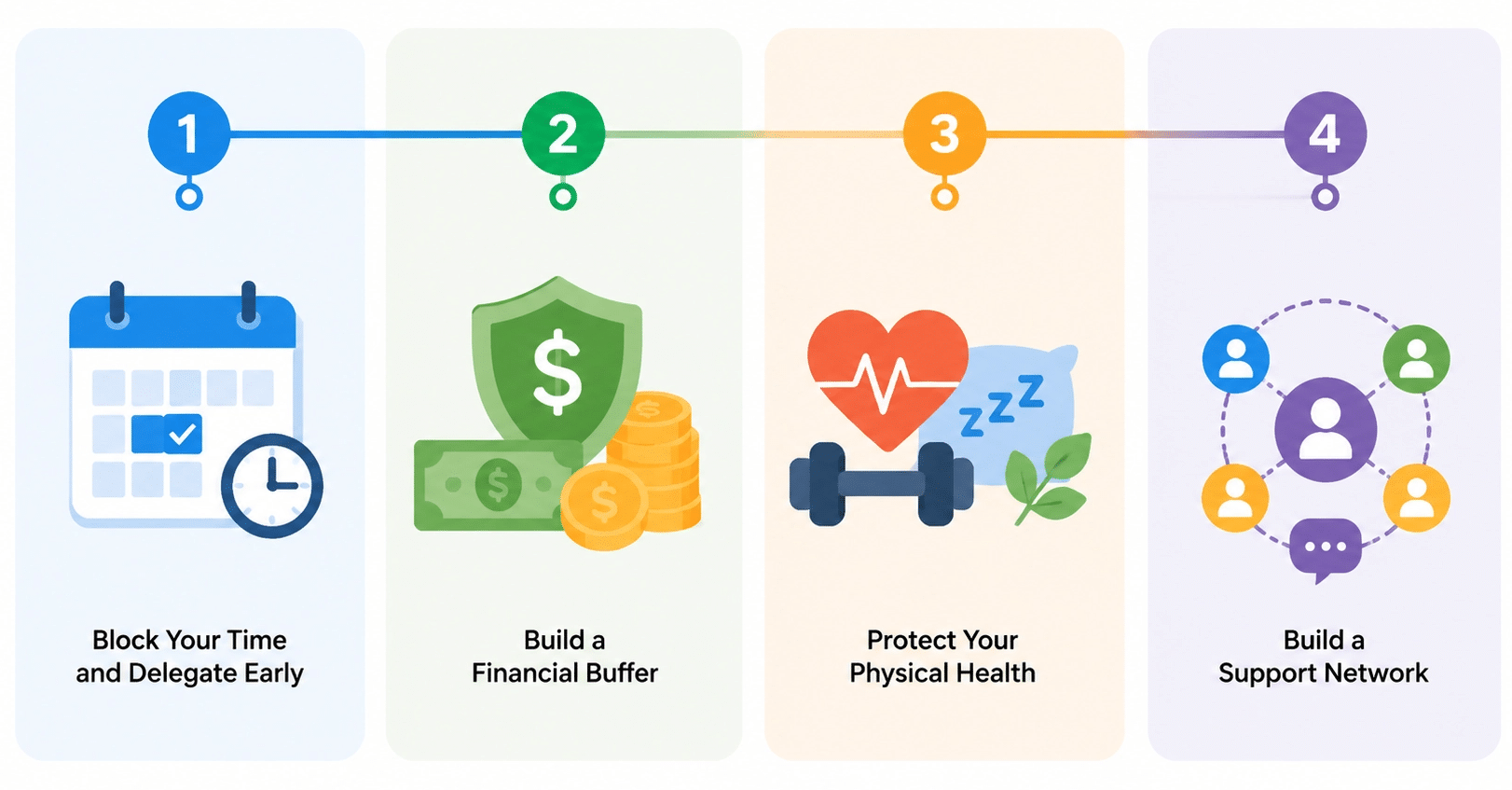
Entrepreneurial stress cannot be eliminated, but you can control it with the right systems. From better time management and delegation to financial planning and personal well-being, small changes can help business owners stay focused, make better decisions, and avoid burnout.
1. Block Your Time and Delegate Early
Time-blocking separates your day into focused work sessions. Assign specific hours to specific tasks. Protect those blocks from interruptions.
Others can handle bookkeeping, social media posting, customer emails, and admin work. Start with one delegated task. Expand from there as trust builds.
2. Build a Financial Buffer
A three-month cash reserve changes how stress feels. One bad month no longer signals disaster. It becomes a temporary dip you can absorb.
Track revenue and expenses weekly, not monthly. Small problems are easy to fix early. The same problems left until month-end can become serious.
Set clear profit margins on every product or service. If a line is not covering its costs, know it sooner rather than later.
3. Protect Your Physical Health
Your business depends on you functioning well. Sleep, exercise, and regular breaks are not optional extras. They directly affect decision quality and stress tolerance.
- Exercise: Even 30 minutes of movement reduces tension and lifts mood
- Sleep: Seven to eight hours protects judgment and emotional control
- Meditation: Ten minutes daily reduces anxiety over time, according to the Mayo Clinic
- Hobbies: Time spent away from the business restores mental focus
4. Build a Support Network
Entrepreneurship is isolating. You make decisions others around you do not fully understand. You carry worries you cannot always share with your team.
A mentor who has built a business before offers perspective that no book can replace. A peer group of fellow founders offers a space to speak openly. Friends and family remind you that life exists outside the business.
Join a local founder group or an online business community. Even one trusted person who understands what you are going through reduces the weight considerably.
Conclusion
The main reason entrepreneurs experience daily stress is carrying complete responsibility with no predictable outcome. Every person who starts a business takes on this weight. It comes with the territory.
What makes the difference is how you manage it. Build a cash buffer. Delegate tasks that do not need you. Protect your sleep and your recovery time. Find people who understand what you are going through.
You cannot remove stress from entrepreneurship. But you can stop it from running your business for you. Start with one change this week. One delegated task, one tracked metric, one protected hour in your day. Small shifts build over time.
Frequently Asked Questions
Who are Gen Z entrepreneurs?
Gen Z entrepreneurs are young business owners born between 1997 and 2012 who use technology, social media, and innovative business models to create and grow companies. Examples include Ben Pasternak, founder of Monkey, and Moziah Bridges, founder of Mo’s Bows.
Who is the youngest girl CEO?
Mikaila Ulmer is one of the youngest girl CEOs, having started her company Me & the Bees Lemonade at the age of 4. She became known for building a successful business while still a child entrepreneur.
Who is the wealthiest Gen Z entrepreneur?
Alexandr Wang, co-founder and CEO of Scale AI, is considered one of the wealthiest Gen Z entrepreneurs. He built an artificial intelligence company valued in the billions.
Who is the top 1 entrepreneur?
There is no official ranking for the world’s number-one entrepreneur, as success depends on factors like innovation, business impact, and wealth. However, Elon Musk is often considered one of the most influential entrepreneurs for founding and leading companies like Tesla, SpaceX, and xAI.
Can you name two famous entrepreneurs?
Two famous entrepreneurs are Elon Musk, known for Tesla and SpaceX, and Jeff Bezos, the founder of Amazon. Both have built globally recognized companies that transformed their industries.