
Business requirements are the starting point for every project. Without them, teams build things nobody asked for. They spend time on the wrong problems. They argue about scope weeks into a build that should have been settled before day one.
Seventy-five percent of business and IT leaders say their projects are at risk before work even begins. Unclear requirements are one of the biggest causes.
This post covers what business requirements are, the different types, how to write them well, and exactly how they differ from functional requirements.
What Are Business Requirements?
A business requirement describes what an organization needs to achieve. It does not describe how to achieve it. It captures the goal or obligation behind a project in plain, non-technical language.
The International Institute of Business Analysis (IIBA) defines it clearly. A business requirement is a condition or capability that a stakeholder needs to solve a problem or reach an objective.
One rule applies to every business requirement: it cannot be built or coded directly. It describes an outcome at the organizational level. When a company wants to cut support tickets by 20%, that is a business requirement. When it specifies that the portal should auto-close resolved tickets after 48 hours, that is a functional requirement.
Think of a business requirement as a marker in the ground. When a team feels lost mid-project, they walk back to that marker and check their direction.
Characteristics of Business Requirements
Not every goal statement qualifies as a strong business requirement. These are the characteristics that make one well-formed and usable.
- High-level and strategic: they define purpose, not process
- Outcome-focused: they state what the business needs, not what the system should do
- Written in plain language: readable by anyone on the team, technical or not
- Owned by senior stakeholders: executives and business owners drive and approve them
- Solution-agnostic: they set the goal without locking in how to reach it
- Relatively stable: they change less often than functional requirements during a project
- Documented in the Business Requirements Document: the BRD is their official record
Business Requirements Examples
Real business requirements are measurable and tied to a specific outcome. Here are four clean examples across different project types.
| Business Requirement | Focus Area |
|---|---|
| Reduce manual processing time by 30% within 12 months | Efficiency outcome |
| Enable customers to pay via digital wallet by Q3 | Revenue and customer experience |
| Increase online customer retention rate by 20% year-over-year | Growth goal |
| Meet annual compliance reporting obligations under industry regulations | Legal or regulatory obligation |
Types of Business Requirements
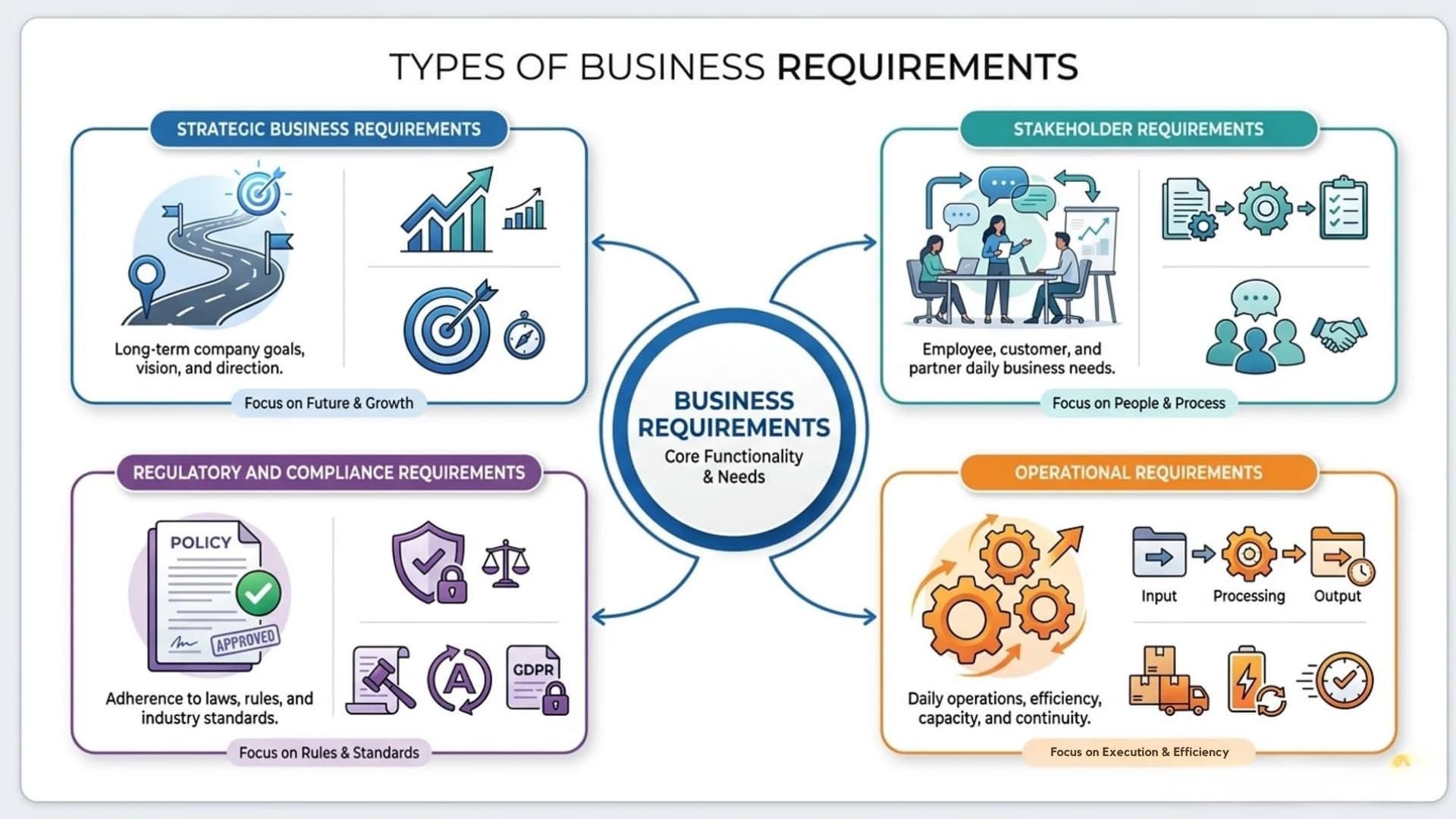
Business requirements are not all the same size. Some cover the whole organization. Some cover one specific process. Knowing which type you are working with keeps planning focused and prevents scope from growing unchecked.
1. Strategic Business Requirements
These connect directly to where the company wants to be in one or two years. They are the highest-level requirements and set the direction for everything below them. “Grow annual recurring revenue by 15%” is a strategic business requirement.
2. Stakeholder Requirements
These come from the people doing the work every day. A warehouse team might need a faster way to check stock levels. A sales team might need fewer steps to send a quote. Stakeholder requirements translate daily friction into project goals.
3. Regulatory and Compliance Requirements
Some business requirements come from outside the company entirely. Laws, regulations, and industry standards create obligations the business must meet. These are non-negotiable and often drive entire projects on their own.
4. Operational Requirements
These describe what the business must be able to do to run day-to-day. Operational business requirements focus on capacity, continuity, and efficiency rather than growth or compliance.
Key Elements Every Business Requirement Should Include
A business requirement without structure is just a wish. Adding these elements turns it into something a team can actually plan and build from.
- A Clear, Measurable Goal: A clear goal explains the exact outcome the business wants to achieve and uses measurable targets to track whether the requirement has been successfully completed.
- Defined Scope and Boundaries: Scope and boundaries outline what the project will cover and what falls outside it, helping teams avoid confusion, delays, and unexpected expansion.
- Success Criteria: Success criteria define the specific results, metrics, or conditions that show whether the business requirement has been met and the project is delivering value.
How to Gather Business Requirements
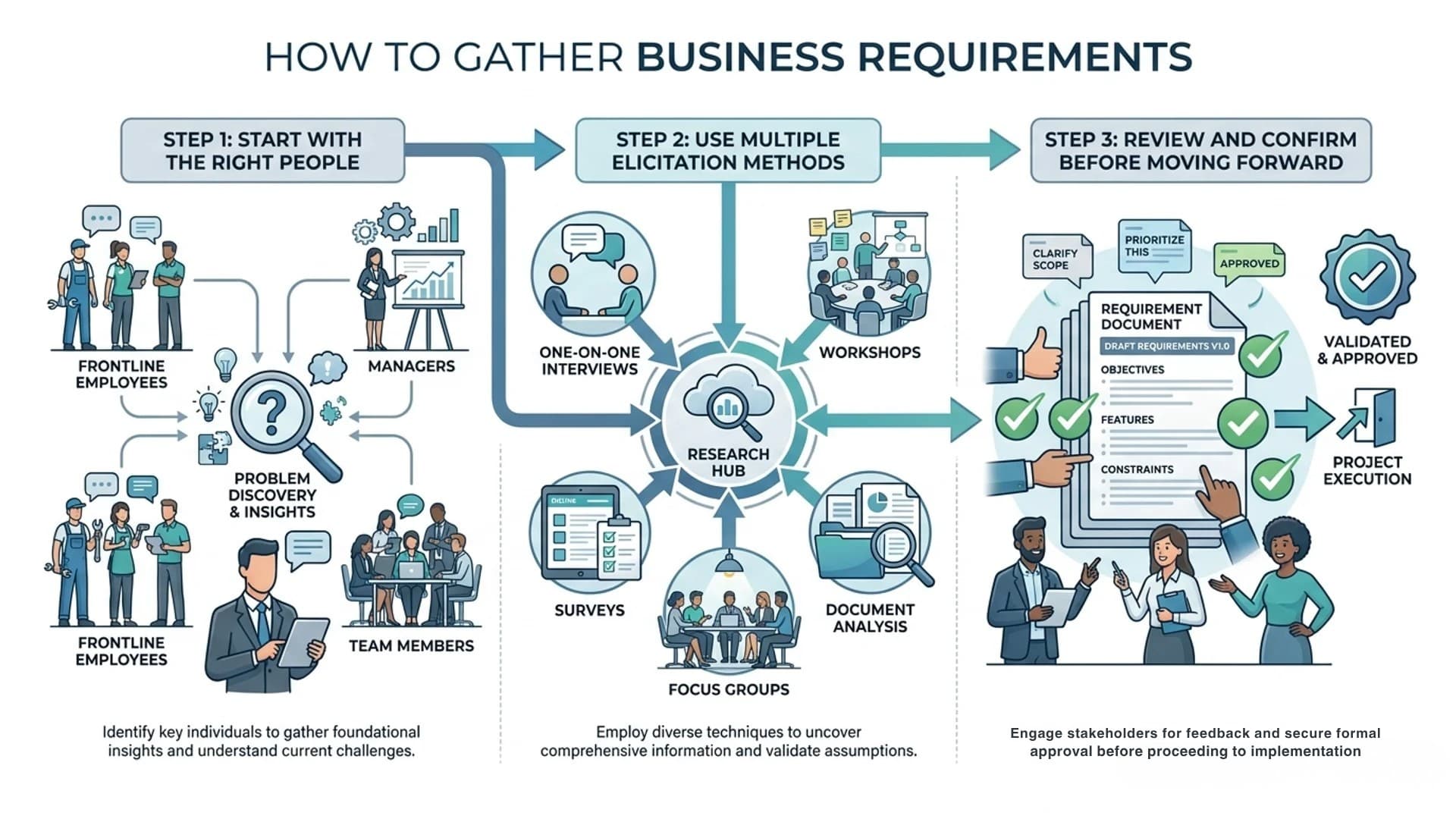
Business requirements do not write themselves. Someone has to go out and find them. The method you use depends on the scope of the project and who holds the relevant knowledge.
Start With the Right People
Start with the people who live with the problem every day, not just the people with the biggest job titles. A worker on the floor often knows more about a broken process than a manager ten levels up ever will. Go to the source of the problem first.
Use Multiple Elicitation Methods
The IIBA’s Business Analysis Body of Knowledge lists several proven approaches for gathering business requirements. Mix and match based on the situation.
- One-on-one interviews: use when you need depth from a single person
- Workshops: use when different departments need to agree in the same room
- Surveys: use when you need answers from a large group quickly
- Document analysis: review existing reports, processes, and past project records
- Focus groups: gather input on specific problems from a targeted group of stakeholders
Review and Confirm Before Moving Forward
Once you have written the requirements down, bring them back to the people who gave you the information. Ask whether you captured it correctly. A mix-up caught here takes ten minutes to fix. The same mix-up caught after launch can cost weeks.
Business Requirements vs Functional Requirements: Key Differences
Business requirements and functional requirements are related, but they answer completely different questions. Mixing them up is one of the most common causes of project failure.
| Dimension | Business Requirements | Functional Requirements |
|---|---|---|
| What they describe | Organizational goals and obligations | Specific system behaviors |
| Primary question | Why are we doing this? | What must the system do? |
| Who owns them | Executives and senior stakeholders | Business analysts and technical teams |
| Level of detail | High-level, strategic | Detailed and specific |
| Directly buildable? | No | Yes |
| Directly testable? | No (measured as business outcomes) | Yes |
| Stability during project | More stable | More likely to change |
| Documented in | BRD | FRD |
A business requirement is the destination. A functional requirement is the route that gets you there. Starting with functional details before defining the business need is like choosing kitchen tiles before deciding how many rooms the house should have.
Paired Examples: Business Requirements vs Functional Requirements
The clearest way to see the difference is to look at both types side by side for the same project goal.
| Business Requirement | Functional Requirement |
|---|---|
| Reduce manual processing time by 30% | The system must process submitted forms within 2 seconds and send a confirmation to the submitter |
| Enable digital wallet payments by Q3 | The system must support PayPal and Apple Pay, validate payment, and return a confirmation number |
| Increase customer retention by 20% | The system must send re-engagement emails to users who have not logged in for 30 days |
Each functional requirement is testable and buildable. Each business requirement above it is not. It describes a goal the business wants to reach, not a system behavior.
Quick Test: Business Requirement or Functional Requirement?
- Can it be directly coded or built? Yes: functional requirement.
- Does it describe an organizational goal without specifying a system? Yes: business requirement.
- Does it describe what a person needs to do, not what a system does? Yes: user requirement.
Still unsure? Ask whether the requirement answers why the project exists. Or ask whether it answers what the system must do. Those two questions point to different layers.
What Is a Business Requirements Document (BRD)?
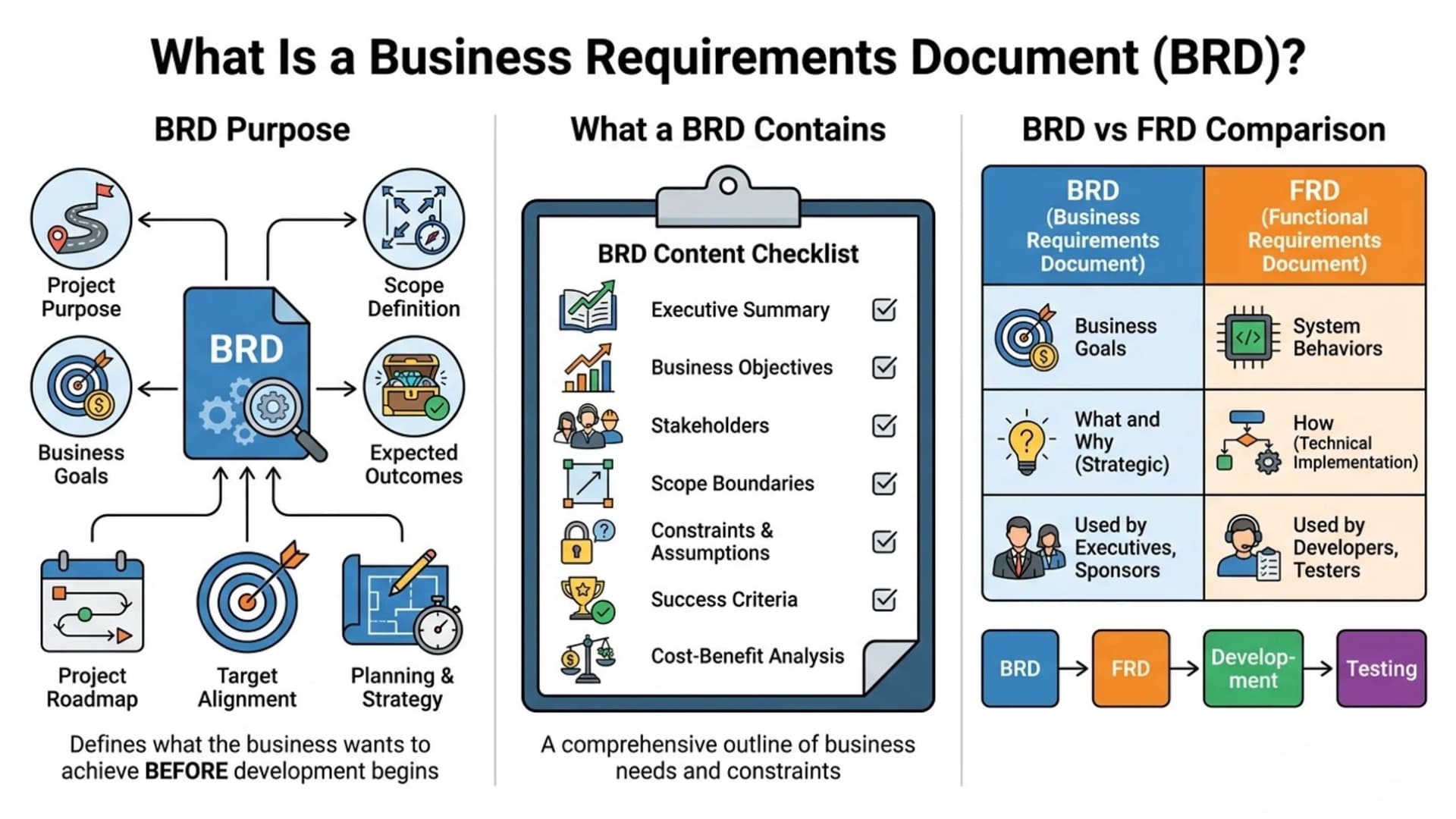
Once you have gathered your business requirements, they need a formal home. That home is the Business Requirements Document.
What a BRD Contains
A BRD captures a project’s purpose and expected outcomes from the business side. It defines the project scope before any design or development begins.
- Executive summary and project background
- Business objectives and goals
- Stakeholder identification
- Scope: what is included and what is not
- Constraints and assumptions
- Success criteria
- Cost-benefit analysis
The BRD audience is executives, project sponsors, and business-side stakeholders. It answers: what are we building and why?
BRD vs FRD: How They Differ
The Functional Requirements Document (FRD) translates the BRD’s goals into specific system behaviors. It is written after the BRD is approved.
Where the BRD answers what and why, the FRD answers how. A typical FRD includes use cases, workflow diagrams, data validation rules, integration requirements, and error handling procedures. Its audience is developers, testers, and QA teams.
When Can You Combine Them?
Startups and small teams often merge both into a single product requirements document (PRD). Enterprises with formal governance usually keep them separate. Whichever format you choose, keep business-level goals and system-level behaviors clearly separated inside the document.
The Layer Most Teams Skip: User Requirements
Business requirements define the goal. Functional requirements define what the system does. Between these two sits a third type that most teams skip: user requirements.
User requirements describe what a person needs to be able to do. They sit between business requirements and functional requirements in the hierarchy.
- Business requirement: “Let customers view their order history”
- User requirement: “A customer must be able to filter their order history by date and status”
- Functional requirement: “The system must display orders filtered by a date range and order status chosen by the user”
User requirements validate that functional requirements are complete. They keep project conversations grounded in what users actually need, not just what the system technically delivers.
Non-Functional Requirements: The Conditions That Get Forgotten
Functional requirements define what a system does. Non-functional requirements define how well it does it. Both sit at the solution level in the requirements hierarchy, but non-functional requirements are the ones teams most often under-document.
- Performance: “The system must respond to user interactions within 2 seconds under normal load”
- Security: “The system must support single sign-on via Active Directory”
- Availability: “The system must be available during standard business hours, with planned maintenance outside those hours”
- Concurrent users: “The system must support up to 10,000 active users at one time”
If your business requirements and functional requirements are solid but your non-functional requirements are vague, problems surface late in the build. Define them early.
The Requirement Hierarchy: How Business Requirements Connect to Everything Else
Business requirements sit at the top of a clear four-layer hierarchy. Understanding how each layer connects prevents the most common classification mistakes and keeps the whole project coherent.
The Flow
Every layer depends on the one above it:
Business requirement → User requirement → Functional requirement → Non-functional requirement → Build → Test
Every functional requirement should trace back to a user requirement. Every user requirement should trace back to a business requirement. This connection is tracked in a requirements traceability matrix. A functional requirement with no traceable business need is a warning sign. It may be out of scope or added without proper approval.
What Goes Wrong When You Get the Layer Wrong
A project sponsor insists on integrating a specific third-party data platform. They call it a business requirement. The actual obligation is to produce a compliance report. No rule mandates a specific platform.
When the team checks the source documents, they find the sponsor’s preference is just that. It is a solution opinion dressed up as a business requirement. Treating it as mandatory locks the team into a technology decision before any evaluation. It changes the scope, the cost estimate, and the vendor shortlist.
Getting the layer right protects the project from decisions made too early.
Common Mistakes When Writing Business Requirements
Even experienced teams fall into the same handful of traps when documenting business requirements. Here are the ones that show up most often.
- Mixing requirement levels: Writing functional details inside the BRD creates confusion for everyone reading it
- Solution-locking the requirement: Saying “we must use Salesforce” when the actual business requirement is “we need a system to track customer interactions”
- Skipping user requirements: Moving from business goals straight to functional specs without asking what users actually need to do
- Ignoring non-functional requirements: Under-documenting performance, security, and availability leads to late-stage build failures
- Vague language: “Improve customer experience” is not a business requirement; “reduce support ticket response time to under 4 hours” is
- No traceability: Building functional requirements with no link back to a business objective is a sign of scope creep in progress
- Treating the BRD as locked: Projects shift mid-way; business requirements that cannot be updated become outdated guides that teams quietly ignore
Getting Business Requirements Right From Day One
Business requirements keep teams focused on solving the right problem instead of building the wrong solution. Define the goal, classify the requirement correctly, and write it clearly before work begins.
Use measurable targets and simple language to align everyone involved. When the business and technical teams share the same understanding, projects move faster and avoid costly confusion.