
Your real estate agent is supposed to fight for you. In dual-agency real estate, that stops being true the moment you sign.
This setup puts one agent on both sides of a deal. That agent represents you and the person across the table at the same time. They cannot tell you what to offer. They cannot push for a better price. They cannot share anything that helps you win.
This post breaks down what dual agency is and where it is legal. You will also see what you give up and what smarter options look like. By the end, you will know whether to accept it or ask for something better.
What Is Dual Agency in Real Estate?
Dual agency in real estate is when one agent represents both the buyer and the seller. The agent owes fiduciary duties to both parties at once.
It happens in two ways. First, a buyer contacts the listing agent directly instead of hiring their own. Second, both the buyer and seller use agents from the same brokerage. In the second case, the brokerage itself becomes the shared agent, even if two separate agents handle each side.
In a normal deal, your agent owes you loyalty, full disclosure, and confidentiality. An agent serving both sides cannot fully deliver any of those things. The seller wants the highest price. The buyer wants the lowest. No single agent can serve both goals at once.
The Consumer Federation of America reports that 10 to 20 percent of home sales involve this arrangement.
How Dual Agency Starts
- At an open house: A buyer meets the listing agent and decides not to hire their own representative.
- Same brokerage: Both buyer and seller independently choose agents from the same firm. The brokerage then steps into the shared agent role.
- Direct outreach: A buyer contacts the listing agent directly about a property they found online.
Is Dual Agency Legal in Your State?
The practice is illegal in eight states as of 2026. All other states allow it with written disclosure and consent.
| State | Dual Agency Status |
|---|---|
| Alaska | Banned |
| Colorado | Banned |
| Florida | Banned |
| Kansas | Banned |
| Maryland | Banned (unless signed consent) |
| Texas | Banned |
| Vermont | Banned |
| Wyoming | Banned |
In the states where dual agency is legal, agents must disclose it in writing. Some states require this before any offer is made. Others allow it “as soon as reasonably possible.”
Many states also offer designated agency as an alternative. Two agents from the same brokerage represent one side each. The conflict shrinks, but the brokerage still profits from both ends of the deal. See the alternatives section below for a full comparison.
The New York State Office of General Counsel has issued a public warning about agent pressure to accept this arrangement. The alert states it compromises the agent’s duty of loyalty to each client.
What a Dual Agent Can and Cannot Do
Once both parties sign the consent form, the agent’s role changes immediately.
| A Dual Agent CANNOT Do This | A Dual Agent CAN Do This |
|---|---|
| Share your bottom-line price with the other party | Pass offers and counteroffers between parties |
| Advise you to accept or reject any offer | Provide factual market data |
| Negotiate hard on your side | Coordinate inspections and paperwork |
| Recommend a specific offer strategy | Answer process-related questions |
| Disclose the other party’s motivation or timeline | Ensure documents are completed correctly |
Gennady Litvin, managing attorney at Moshes Law, explains it directly. He notes the agent is no longer the exclusive negotiator for either the buyer or the seller. The agent cannot give the same undivided loyalty a dedicated agent would.
The agent goes from advocate to referee. Say you tell them you will accept $20,000 less than asking. They may be legally required to share that fact with the other side.
The Real Risks of Dual Agency
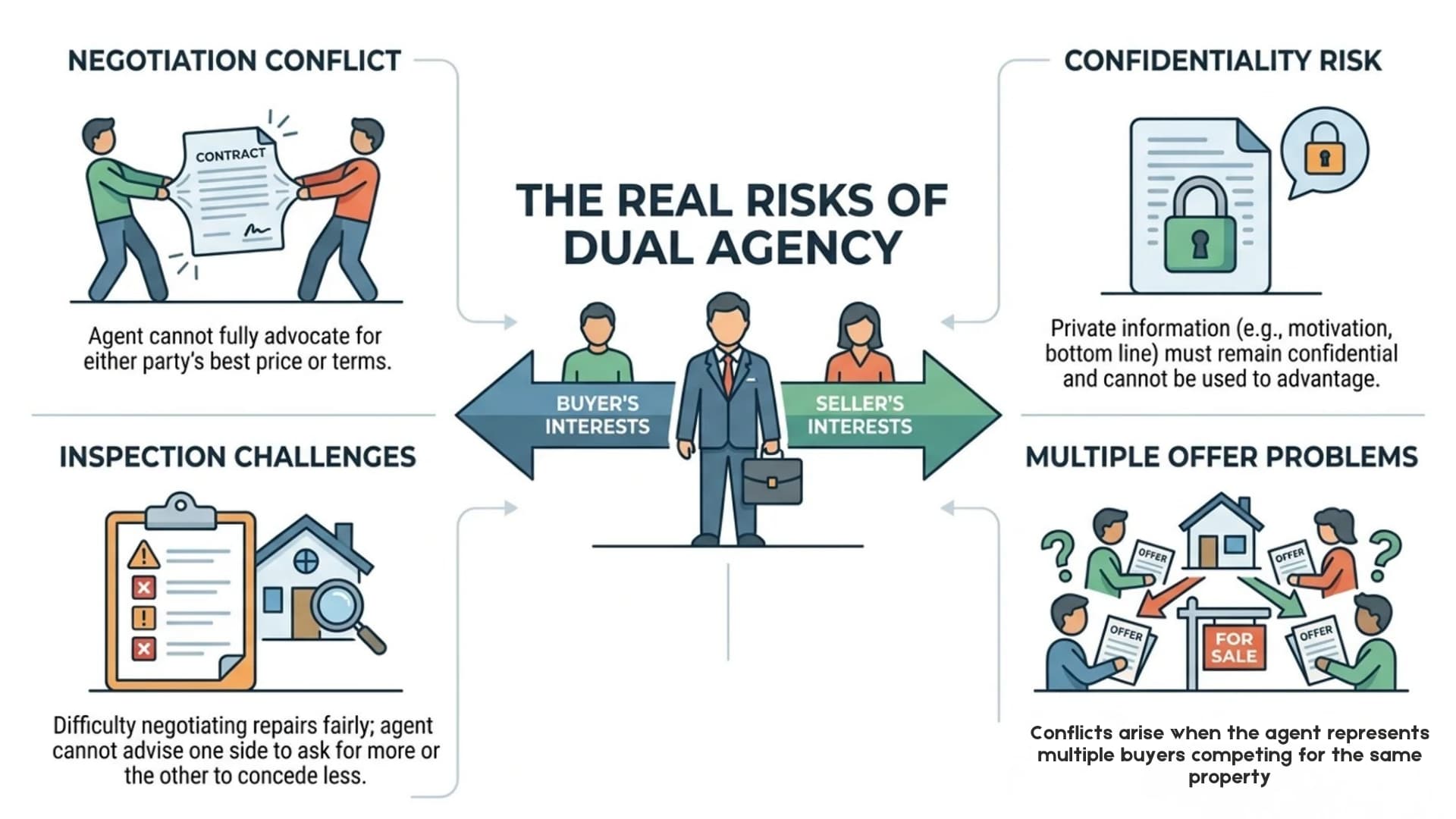
Dual agency can create serious conflicts when one agent represents both sides of a deal. Understanding these risks helps buyers and sellers protect their interests.
1. The Negotiation Problem
Here is how a real deal can go wrong with one agent on both sides.
A seller tells their dual agent they will accept $450,000. The listing price is $475,000. The buyer tells the same agent they will pay up to $460,000 but plans to start at $440,000.
The agent now knows both limits. In a standard deal, two separate agents push and pull until they land around $460,000 to $465,000. With one shared agent, the transaction might settle at $450,000. The buyer wins. The seller leaves money behind.
2. Inspection Complications
When a home inspection turns up problems, both sides have opposite goals. A buyer wants repairs or a price cut. A seller wants to move on. An agent serving both sides cannot push for either outcome.
3. Multiple Offer Situations
When two or more buyers submit offers, the agent faces a clear conflict. They represent one of those buyers. Helping that buyer win hurts the others. Some of those competing buyers may also be clients at the same brokerage.
4. The Commission Math
Commission savings look appealing on paper. A 2 percent reduction on a $300,000 home saves the seller $6,000. A weak negotiation on price can cost $15,000 to $20,000 more. The numbers rarely work in your favor.
Pros and Cons of Dual Agency
Here’s an honest look at both sides:
| Factor | Benefit | Drawback |
|---|---|---|
| Communication | Faster, one contact point | You lose a filter between parties |
| Commission | Agent may accept a lower rate | Savings rarely offset lost advocacy |
| Speed | Fewer people, fewer delays | Less time to review terms carefully |
| Negotiation | Less back-and-forth | No one pushes hard for your side |
| Loyalty | N/A | The agent serves two opposing interests |
How to Protect Yourself in a Dual Agency Situation
Sometimes you do not realize this situation exists until the deal is already underway. These steps can help protect your position.
Questions to Ask Before Agreeing
- “How will you handle confidential information I share with you?”
- “What services am I giving up compared to full representation?”
- “Will you reduce your commission since you represent both sides?”
- “How will you handle a multiple-offer situation?”
- “Can I bring in a real estate attorney to review documents?”
Steps to Take Once You Are In It
- Hire a real estate attorney. This is the single most effective step. An attorney reviews contracts, flags risks, and gives you advice the dual agent legally cannot.
- Do your own market research. Do not rely on the agent for price analysis. Check comparable sales yourself using public records or platforms like Zillow or Redfin.
- Keep your limits private. Do not share your real budget, timeline, or backup options with the dual agent.
- Put everything in writing. Document every agreement, deadline, and term clearly.
- Negotiate yourself. In this setup, no one else will do it for you.
Pro Tip: Before signing a consent form, ask about bringing in a real estate attorney to review the contract. Most states allow this. It gives you an independent set of eyes on the deal.
Better Alternatives to Dual Agency
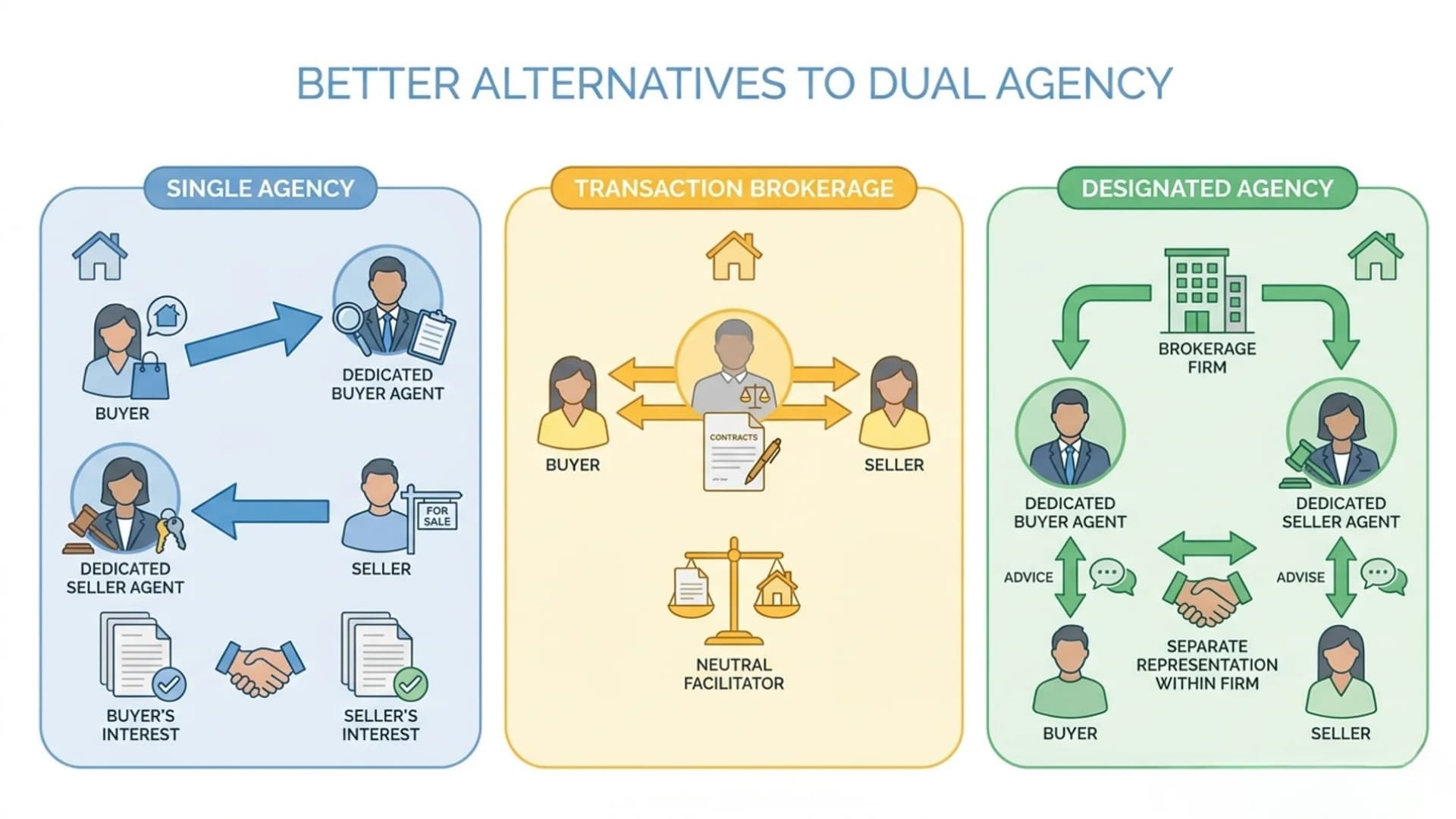
If dual agency feels risky, other options give you clearer representation and fewer conflicts. These alternatives help buyers and sellers keep stronger control over negotiations and decisions.
Single Agency
Single agency is the standard model. Your agent works only for you.
For sellers, the listing agent focuses entirely on getting the best price. For buyers, the buyer’s agent searches for properties, flags problems, and negotiates on your behalf.
The commission is typically 5 to 6 percent split between two agents. You get full advocacy in return. For most buyers and sellers, that trade is worth more than any savings from shared representation.
Transaction Brokerage
Transaction brokerage sits between dual agency and full representation. The broker handles paperwork without representing either side formally.
Florida requires this model instead of dual agency. The broker stays neutral, manages the process, and is transparent that they are not representing you. The relationship is clearer: they are not your advocate, and they say so up front. This works well for experienced buyers and sellers who are comfortable handling negotiations on their own.
Designated Agency
Designated agency gives each party their own agent, even when both agents work for the same brokerage. Each agent can advocate for their specific client.
The conflict of interest shrinks, though the brokerage still earns on both sides. Zachary Schorr, a California real estate attorney, notes that designated agency is generally safer because each client retains individual guidance.
Which Option Fits Your Situation?
| Your Situation | Best Choice |
|---|---|
| First-time buyer or seller | Single agency |
| Complex property or legal questions | Single agency plus attorney |
| Experienced buyer with a pre-arranged deal | Transaction brokerage |
| Both parties have already agreed on price | Transaction brokerage |
| Offered dual agency with no other option available | Hire an attorney immediately |
Should You Accept Dual Agency in Real Estate?
Dual agency real estate is legal in most states. But legal does not mean smart.
When you agree to this arrangement, you trade away the one thing that makes an agent worth hiring. That one thing: someone whose entire job is to get you a better deal.
The commission savings look good until you realize what you gave up. No advocacy. No confidentiality. No one in your corner.
If you are buying or selling, push for single agency. If you find yourself in this situation, bring in a real estate attorney before you sign anything. That one step protects you far more than any commission discount ever will.
Have you dealt with dual agency before? Share your experience in the comments.
Frequently Asked Questions
Can I switch agents if dual agency was not disclosed upfront?
Yes. Undisclosed dual agency may give you grounds to end the agreement. Check your state’s disclosure laws. You may also have legal recourse if the failure caused financial harm.
Does dual agency affect how long a home sits on the market?
It can. An agent working both sides has financial motivation to close fast. That pressure may push both parties to settle sooner than is ideal.
What is the difference between dual agency and designated agency?
In dual agency, one agent serves both parties. In designated agency, two agents from the same brokerage each serve one side separately.
Can a buyer’s agent become a dual agent mid-transaction?
Yes. If your buyer’s agent also lists a property you want to buy, they may propose dual agency. You have the right to decline and request a different agent.
Does a dual agent earn more commission than a regular agent?
Often yes. A dual agent keeps the full commission instead of splitting it with a second agent. You can and should negotiate this rate down.