
Profit is the money left after a business pays all its costs. A company can earn $500,000 in revenue and still lose money if expenses run higher.
These profit examples break down the calculations you need: gross profit, operating profit, net profit, and profit margin. Each section uses real numbers from retail stores, service businesses, and freelancers.
Note: All figures in this article are for educational purposes. For financial advice specific to your business, consult a qualified accountant.
What Are Profit Examples?
Profit examples show how different businesses calculate earnings after removing costs. The basic formula is:
Profit = Revenue − Expenses
If a business earns $10,000 and spends $7,000 on products, wages, rent, and other costs:
$10,000 − $7,000 = $3,000 profit
That $3,000 is what the business keeps. Profit is not one fixed number. Three types appear on most financial statements, and each one strips away a different layer of costs.
| Profit Type | What It Measures |
|---|---|
| Gross Profit | Revenue minus direct production costs |
| Operating Profit | Gross profit minus daily operating expenses |
| Net Profit | Revenue minus all costs, including taxes and interest |
Using all three gives a complete view of where money is being spent and where it is being kept.
Types of Profit With Formulas
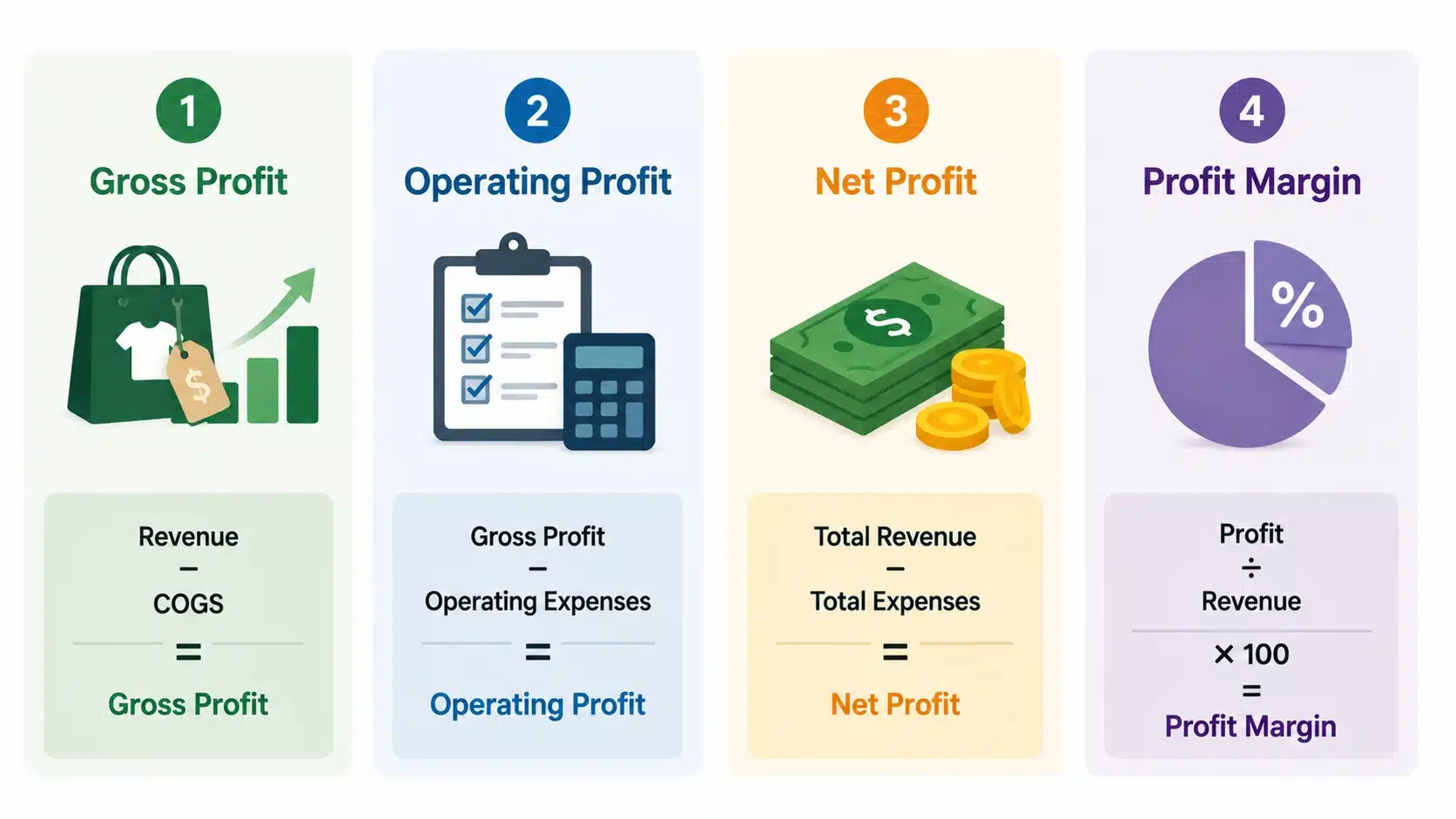
Businesses use various profit metrics to assess different aspects of their financial performance.
1. Gross Profit
Gross profit is what remains after subtracting the direct cost of goods sold (COGS). COGS includes raw materials, production costs, and direct labor. It does not cover rent, non-production salaries, or marketing.
Gross Profit = Revenue − Cost of Goods Sold (COGS)
Example: A clothing store earns $50,000 in monthly sales. Inventory costs $22,000.
$50,000 − $22,000 = $28,000 gross profit
The store earns $28,000 before paying any operating expenses.
2. Operating Profit
Operating profit removes the day-to-day costs of running the business.
Operating Profit = Gross Profit − Operating Expenses
Operating expenses include employee salaries, rent, utilities, marketing, and software subscriptions.
Example: Gross profit is $28,000. Operating expenses total $18,000.
$28,000 − $18,000 = $10,000 operating profit
3. Net Profit
Net profit is the final amount left after all costs are paid. This includes taxes, loan interest, and one-time expenses. It is often called the “bottom line” because it appears last on a profit and loss statement.
Net Profit = Total Revenue − Total Expenses
Example: Revenue is $100,000. Total expenses are $75,000.
$100,000 − $75,000 = $25,000 net profit
4. Profit Margin
Profit margin converts profit into a percentage of revenue. This makes it easier to compare performance across businesses of different sizes.
Profit Margin = (Profit ÷ Revenue) × 100
Example: Profit is $25,000. Revenue is $100,000.
($25,000 ÷ $100,000) × 100 = 25% profit margin
A 25% margin means the business keeps $0.25 from every $1.00 earned.
Profit Examples by Business Type
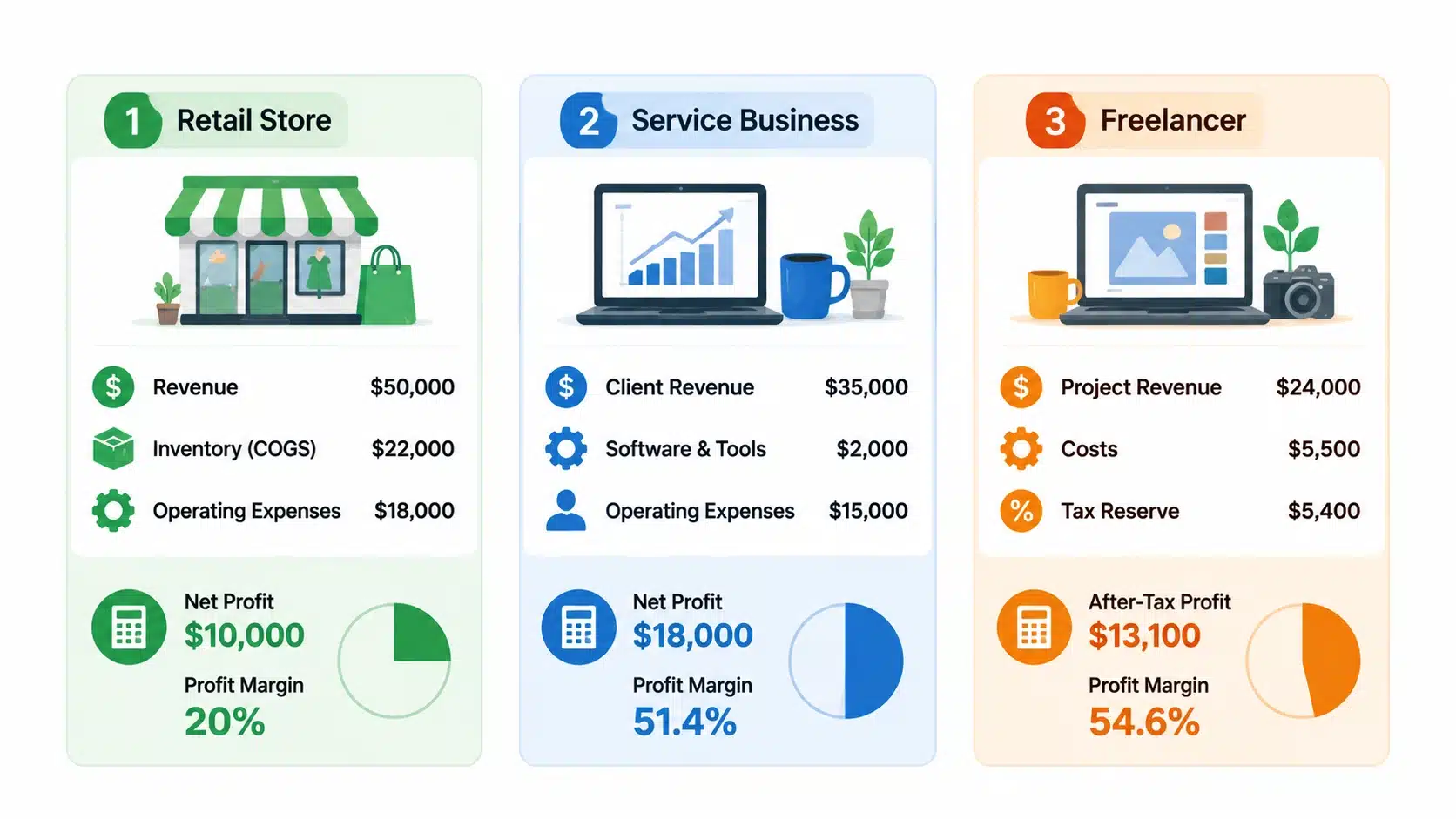
The following profit examples use step-by-step calculations across three common business types.
1. Retail Store
A clothing boutique reviews its monthly figures.
| Category | Amount |
|---|---|
| Revenue from sales | $50,000 |
| Inventory cost (COGS) | $22,000 |
| Operating expenses (rent, wages, utilities, marketing) | $18,000 |
Step 1: Gross Profit
$50,000 − $22,000 = $28,000
Step 2: Net Profit
$28,000 − $18,000 = $10,000
Profit Margin:
($10,000 ÷ $50,000) × 100 = 20%
Retail businesses carry high inventory and rent costs. A 20% net margin is a reasonable result for this business type. Grocery and electronics retailers often see lower margins, while specialty boutiques can push higher.
2. Service Business
A small business IT consulting firm completes several client projects each month. Service businesses spend far less on physical inventory, which significantly changes the profit structure.
| Category | Amount |
|---|---|
| Client revenue | $35,000 |
| Software and tools | $2,000 |
| Salaries, office costs, marketing | $15,000 |
Step 1: Gross Profit
$35,000 − $2,000 = $33,000
Step 2: Net Profit
$33,000 − $15,000 = $18,000
Profit Margin:
($18,000 ÷ $35,000) × 100 = 51.4%
Service businesses often see higher margins when operating costs stay controlled. The key cost to watch is staffing, which typically takes the largest share of operating expenses in this model.
3. Freelancer
A freelance graphic designer calculates profit for a full quarter. Freelancers must account for self-employment tax, which an employer normally covers in a salaried role.
| Category | Amount |
|---|---|
| Project revenue | $24,000 |
| Direct project costs (software, stock images) | $3,000 |
| Equipment, internet, home office | $2,500 |
| Tax reserve | $5,400 |
Step 1: Gross Profit
$24,000 − $3,000 = $21,000
Step 2: Operating Profit
$21,000 − $2,500 = $18,500
Step 3: After-Tax Profit
$18,500 − $5,400 = $13,100
Setting aside a tax reserve each quarter prevents a large unexpected bill at year-end. A common rule is to reserve 25 to 30 percent of net earnings, though the exact rate depends on total annual income.
Profit Margin Examples by Industry
Profit margins differ across industries because costs, pricing models, and competition all vary. The table below compares net margins across common business types.
| Industry | Revenue | Net Profit | Margin |
|---|---|---|---|
| Retail clothing | $100,000 | $10,000 | 10% |
| Software | $500,000 | $200,000 | 40% |
| Restaurant | $80,000 | $7,000 | 8.75% |
| Consulting | $35,000 | $18,000 | 51.4% |
Restaurants pay high food and labor costs, which limits margin. Software businesses can sell additional licenses without significant extra production costs, so margins tend to be higher. A 10% net margin is typical in retail. That same figure would signal a performance problem for a software company.
Rather than using a single benchmark, compare margins with other businesses in the same industry and of a similar size.
Profit vs Revenue vs Cash Flow
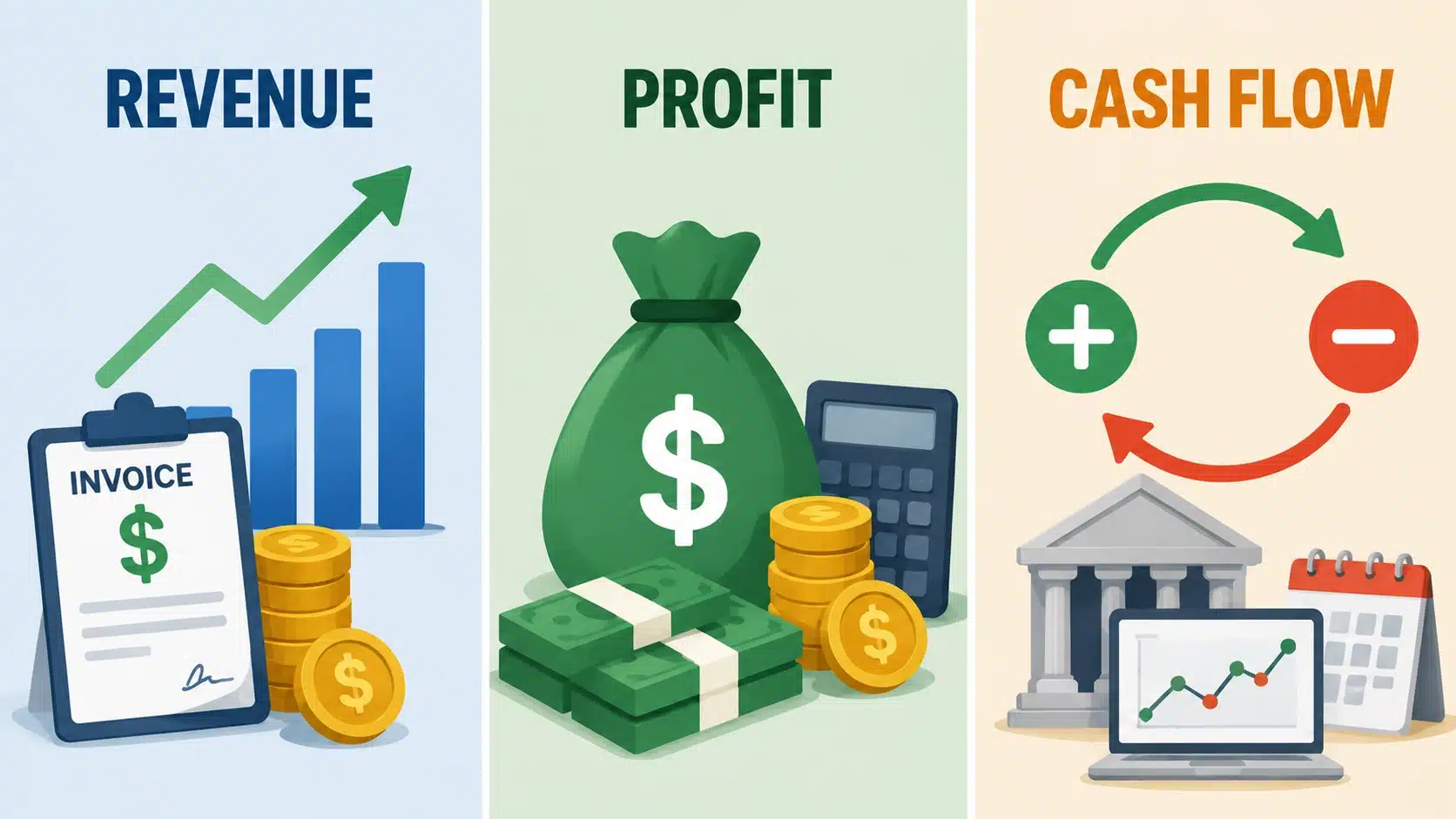
These three financial terms measure different things.
- Revenue is total money earned from sales before any costs are removed.
- Profit is what remains after paying all expenses.
- Cash flow is the actual movement of money in and out of the business at a given time.
A business can be profitable on paper while struggling to pay its bills. Here is a direct example.
A construction firm completes a $200,000 project and records a $50,000 profit. The client pays 90 days after the work is done. During that period, the business still needs to pay wages, materials, and rent. Profit shows up on the income statement. The cash to cover costs has not arrived yet.
This is why tracking both profit and cash flow matters. Profit shows long-term financial performance. Cash flow shows short-term ability to meet obligations.
How to Use Profit Calculations for Pricing
Profit calculations are not just for measuring past performance. They help set better prices going forward.
If a product sells for $80 and costs $50 to produce, the gross profit is $30. The gross margin is 37.5%. If the business needs a 50% margin to cover overhead, it must either raise the price to $100 or reduce the production cost to $40.
Running this calculation before setting a price prevents underpricing. A price that looks profitable on the surface may not cover operating expenses once you include salaries, rent, and other costs. Use net profit as the final check, not gross profit alone.
Common Mistakes in Profit Calculations
These errors appear regularly and often lead to decisions based on incorrect figures.
1. Leaving out hidden costs
Returns, payment processing fees, and refunds are easy to miss. A $10,000 gross profit figure can fall to $7,200 once those costs are factored in. Always include every cost before finalizing a profit number.
2. Reading revenue as profit
Revenue shows sales volume. A business earning $500,000 in revenue but spending $520,000 is losing $20,000. Profit reveals what the business actually keeps after all costs are settled.
3. Judging performance on a single month
A landscaping company may earn strong profits in summer and post losses in winter. Reviewing profit over a full year gives a far more accurate view of financial health.
Frequently Asked Questions
What is a simple profit example?
A product costs $40 to buy and sells for $65. Profit = $65 − $40 = $25. The profit margin is 38.5%.
What is the difference between gross profit and net profit?
Gross profit subtracts only direct production costs. Net profit subtracts all costs, including taxes, interest, and overhead expenses.
What is a good profit margin?
It depends on the industry. Retail margins around 10% are typical. Software companies often reach 40% or higher. Compare margins against similar businesses in the same market rather than using a fixed target.
Can a business have high revenue and no profit?
Yes. Revenue of $500,000 with $550,000 in expenses results in a $50,000 loss. Sales volume alone does not confirm that a business is financially healthy.
Why track both profit and cash flow?
Profit measures financial performance over a set period. Cash flow tracks money movement in real time. A business may show strong profit but still struggle to pay wages if customer payments arrive late.
Track Profit Regularly to Improve Your Results
These profit examples show how money moves from total sales down to final earnings. Gross profit reveals how well a business prices its products. Operating profit shows how efficiently it runs. Net profit confirms what actually stays after every cost is settled.
For any business type, from a retail shop to a freelance practice, these profit formulas work the same way.
Calculate all three profit types regularly to catch pricing problems early, control costs, and plan for growth. Start with your most recent income figures and run through each step above.