A missed payroll filing. A data breach. A hiring practice that breaks federal rules. Each of these mistakes can result in fines, lawsuits, or worse.
Compliance in business means following the laws, regulations, and standards that apply to your company. That includes paying employees correctly, protecting customer data, filing taxes on time, and meeting workplace safety requirements.
It applies to businesses of all sizes. Small businesses face the same federal rules as large corporations, even without a legal team on staff.
This post explains what compliance in business means and why it matters. It also covers key US regulations and steps to keep your business legally protected.
What Is Compliance in Business?
Compliance in business means following all laws, regulations, and industry standards that apply to your company. This includes legal requirements and ethical practices.
Legal compliance means meeting government mandates. Ethical compliance means going beyond the law to do what is right.
Requirements vary by industry, location, and business size. A healthcare startup in California faces different rules than a manufacturer in Texas. A tech company handling EU customer data must follow GDPR rules, even if it operates from the US.
Staying compliant protects your business from legal risk and builds trust with customers, partners, and regulators.
Data privacy laws, environmental rules, and workplace equity standards continue to expand. Understanding compliance is now a basic requirement for running a business.
Why Does Business Compliance Matter?
Business compliance matters because non-compliance is costly. Fines, lawsuits, and reputational damage can shut down a company. These risks are highest for businesses that ignore compliance or cut corners. But done right, compliance also builds long-term value.
When your business meets standards like the CCPA or OSHA, customers and partners trust you more. Compliance also prevents the fines, lawsuits, and closures that drain time and money.
Investors and lenders view compliant businesses as lower risk. Clear internal policies reduce errors and speed up operations.
Companies with strong compliance records, especially in environmental and data privacy areas, attract better clients and employees.
What Are the Main Types of Business Compliance?
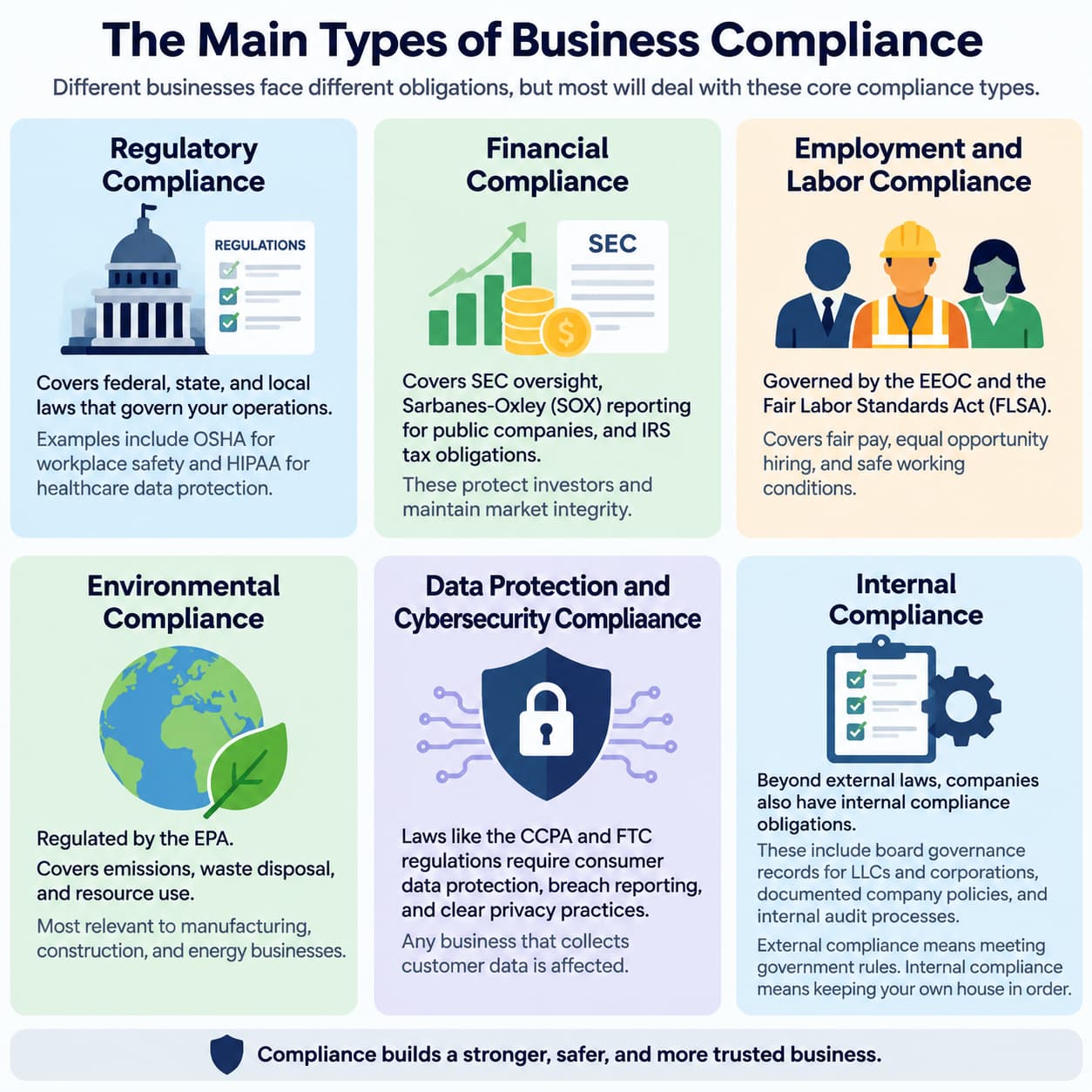
Business compliance is not one-size-fits-all. Each company has a different mix of obligations. Most businesses, however, will deal with several of these core compliance types.
Regulatory Compliance: Covers federal, state, and local laws that govern your operations. Examples include OSHA for workplace safety and HIPAA for healthcare data protection.
Financial Compliance: Covers SEC oversight, Sarbanes-Oxley (SOX) reporting for public companies, and IRS tax obligations. These protect investors and maintain market integrity.
Employment and Labor Compliance: Governed by the EEOC and the Fair Labor Standards Act (FLSA). Covers fair pay, equal opportunity hiring, and safe working conditions.
Environmental Compliance: Regulated by the EPA. Covers emissions, waste disposal, and resource use. Most relevant to manufacturing, construction, and energy businesses.
Data Protection and Cybersecurity Compliance: Laws like the CCPA and FTC regulations require consumer data protection, breach reporting, and clear privacy practices. Any business that collects customer data is affected.
Internal Compliance: Beyond external laws, companies also have internal compliance obligations. These include board governance records for LLCs and corporations, documented company policies, and internal audit processes. External compliance means meeting government rules. Internal compliance means keeping your own house in order.
Key Business Compliance Requirements and US Regulations to Know
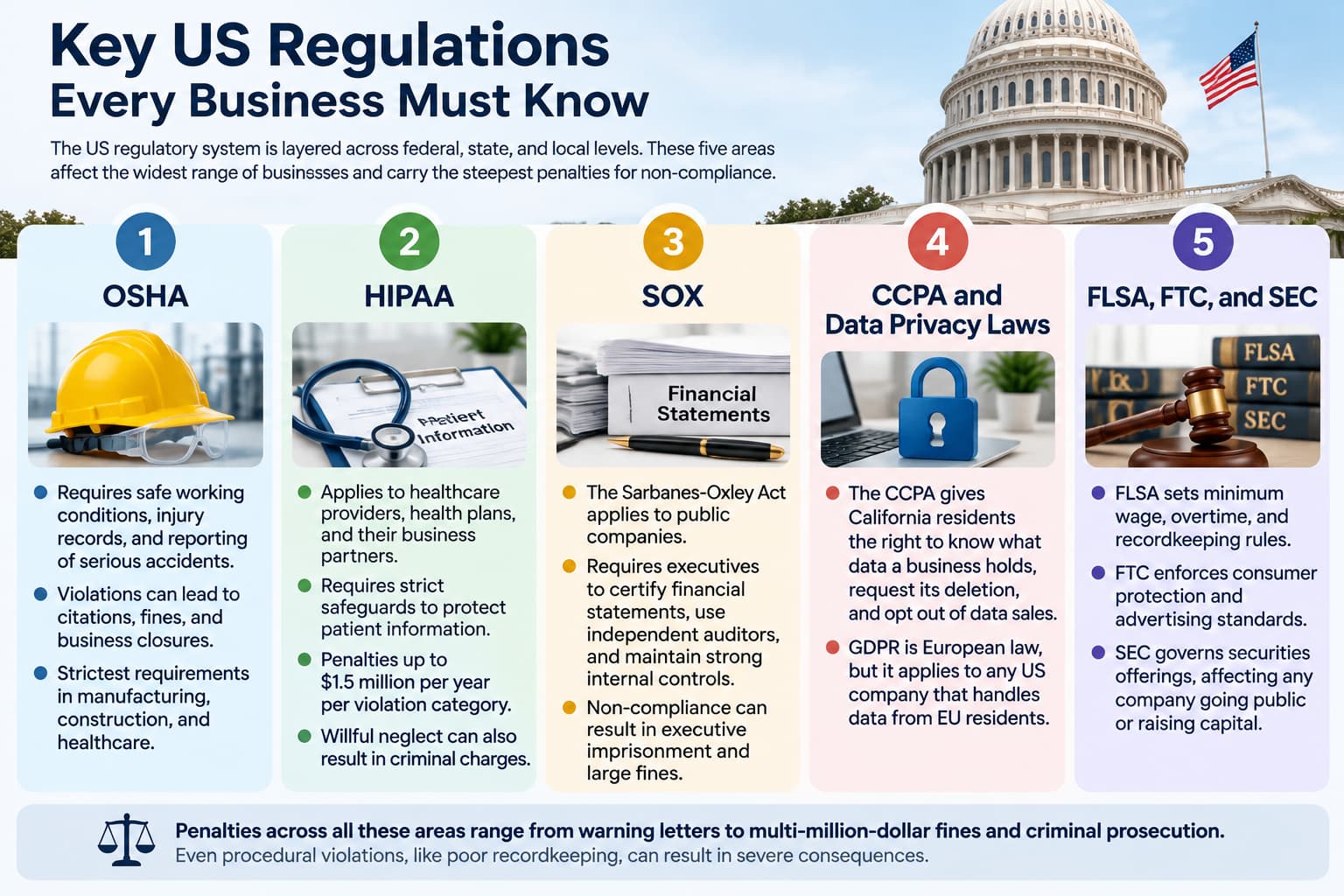
The US regulatory system is layered across federal, state, and local levels. These five areas affect the widest range of businesses and carry the steepest penalties for non-compliance.
1. OSHA
OSHA requires employers to provide safe working conditions, keep injury records, and report serious workplace accidents. Violations can result in citations, fines, and business closures. The manufacturing, construction, and healthcare industries face the strictest OSHA requirements.
2. HIPAA
HIPAA applies to healthcare providers, health plans, and their business partners. It requires strict safeguards to protect patient information.
The US Department of Health and Human Services sets civil penalties up to $1.5 million per year per violation category. Willful neglect can also result in criminal charges.
3. SOX
The Sarbanes-Oxley Act applies to public companies. It requires executives to certify financial statements, use independent auditors, and maintain strong internal controls. Non-compliance can result in executive imprisonment and large fines.
4. CCPA and Data Privacy Laws
The CCPA gives California residents three rights. They can ask what data a business holds, request its deletion, and opt out of data sales. While GDPR is European law, it applies to any US company that handles data from EU residents.
5. FLSA, FTC, and SEC
The Fair Labor Standards Act (FLSA) sets minimum wage, overtime, and recordkeeping rules. The FTC enforces consumer protection and advertising standards. The SEC governs securities offerings, affecting any company going public or raising capital.
Penalties across all these areas range from warning letters to multi-million-dollar fines and criminal prosecution. Even procedural violations, like poor recordkeeping, can result in severe consequences.
Who Is Responsible for Business Compliance?
Compliance responsibility depends on the size and structure of your business. In every case, someone needs to own it.
In a sole proprietorship or small LLC, the business owner handles compliance directly. That means tracking filing deadlines, maintaining payroll records, and staying up to date on labor law changes.
As a business grows, compliance tasks often shift to an HR manager, office manager, or accountant.
Large corporations typically hire a dedicated compliance officer or build a full compliance department. This team monitors regulatory changes, runs internal audits, and trains staff.
Regardless of business size, external advisors like lawyers and accountants provide valuable support. But internal ownership of compliance, with clear roles and documented policies, is what actually keeps a business protected.
How to Keep Your Business Compliant
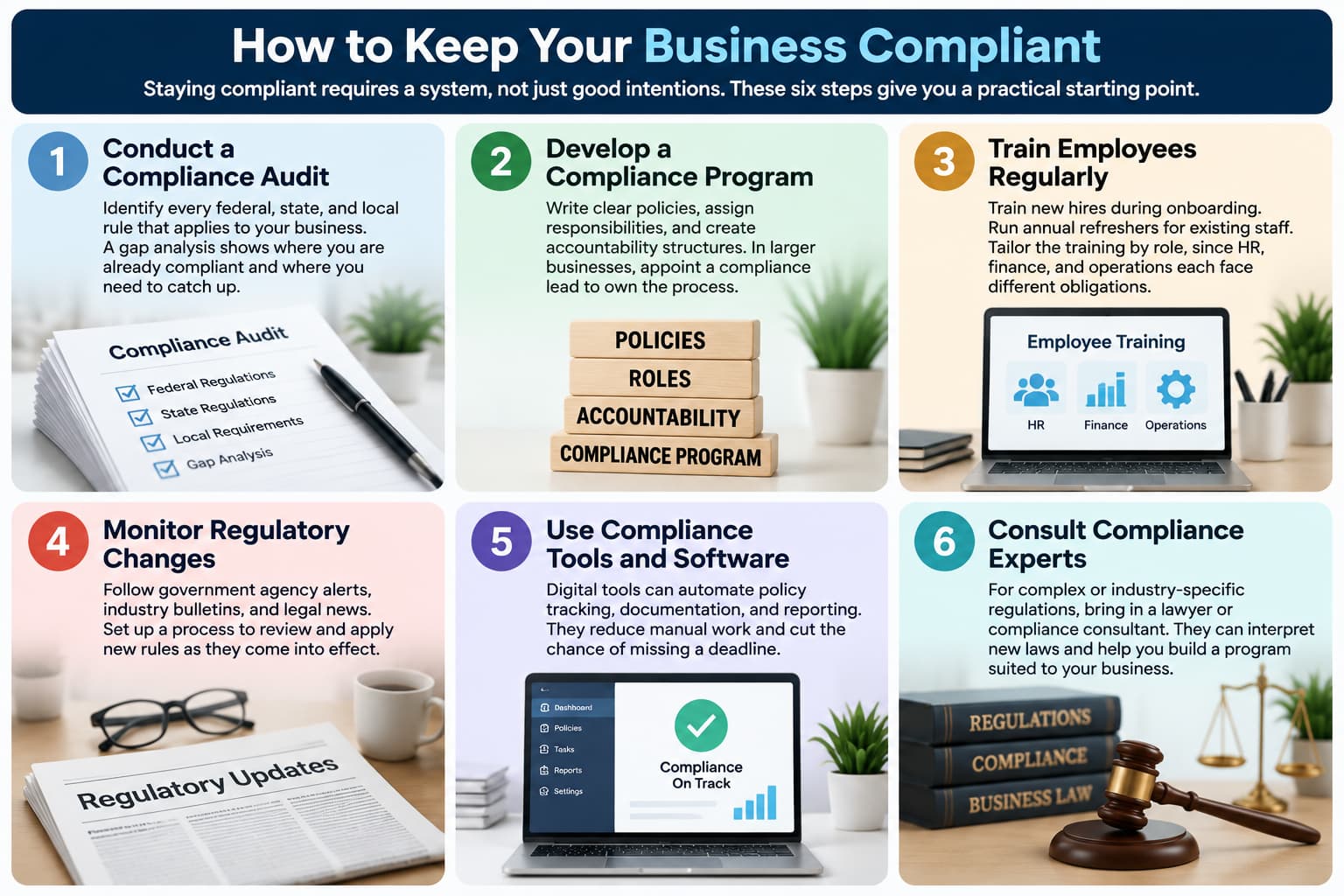
Staying compliant requires a system, not just good intentions. These six steps give you a practical starting point.
-
Conduct a Compliance Audit: Identify every federal, state, and local rule that applies to your business. A gap analysis shows where you are already compliant and where you need to catch up.
-
Develop a Compliance Program: Write clear policies, assign responsibilities, and create accountability structures. In larger businesses, appoint a compliance lead to own the process.
-
Train Employees Regularly: Train new hires during onboarding. Run annual refreshers for existing staff. Tailor the training by role, since HR, finance, and operations each face different obligations.
-
Monitor Regulatory Changes: Follow government agency alerts, industry bulletins, and legal news. Set up a process to review and apply new rules as they come into effect.
-
Use Compliance Tools and Software: Digital tools can automate policy tracking, documentation, and reporting. They reduce manual work and cut the chance of missing a deadline.
-
Consult Compliance Experts: For complex or industry-specific regulations, bring in a lawyer or compliance consultant. They can interpret new laws and help you build a program suited to your business.
How to Build a Compliance Culture at Work
Rules on paper do not protect a business on their own. Compliance has to become part of how your team operates.
Leadership sets the tone. When managers prioritize compliance in decisions and budgets, employees follow.
HR can reinforce this by including compliance in performance reviews and recognizing employees who flag problems early.
When employees face a gray area, give them a simple framework: Is it legal? Does it meet our policies? Does it treat stakeholders fairly? If any answer is unclear, escalate.
Anonymous reporting channels let employees raise concerns without fear of retaliation. Internal audits catch problems before regulators do.
A real compliance culture turns rule-following into a shared standard, one that holds up through staff changes and business growth.
Common Business Compliance Mistakes to Avoid
Several compliance failures follow the same pattern. Knowing where businesses typically go wrong helps you avoid the same problems.
|
Mistake |
Why It Happens |
How to Avoid It |
|---|---|---|
|
Overlooking State and Local Laws |
Businesses focus on federal rules and miss state or city requirements. |
Run location-specific reviews. Keep separate checklists for each state or city where you operate. |
|
Ignoring Employee Training |
Staff is not told what the rules are or what their role is. |
Run mandatory, role-specific training. Track completion. Refresh it annually. |
|
Weak Documentation |
No system is in place to store records, so audits are hard to pass. |
Use digital tools to store documents with clear retention schedules. Make records easy to pull during an audit. |
|
Failing to Track Regulatory Changes |
No one is assigned to watch for legal changes, so old practices stay in place. |
Assign one person to monitor regulatory updates and manage the rollout of changes. |
|
Treating Compliance as a One-Time Task |
Businesses complete an initial setup and assume they are done. |
Schedule quarterly compliance check-ins. Treat it as an ongoing process, not a project. |
Fixing a compliance violation after the fact costs far more than preventing it. Build the habits now
Stay Compliant and Protect Your Business
Compliance in business is not about adding paperwork to your day. It is about protecting what you have built.
A business that follows employment law, meets data privacy rules, and keeps accurate financial records survives audits. It retains clients and avoids fines that derail growth.
The regulations will keep changing. New data privacy laws, updated labor standards, and expanded environmental rules are already in the pipeline.
Start with a compliance audit. Map out what applies to your business at the federal, state, and local level. Assign clear ownership. Train your team. Then treat it as an ongoing part of operations, not a one-time fix.
Businesses that build compliance into their daily operations spend less time in crisis mode and more time growing.
Frequently Asked Questions
What happens if a small business fails a compliance audit?
A failed audit can lead to fines, a corrective action order, or business closure. Regulators often allow a remediation window for first-time violations before escalating penalties.
Do sole proprietors need to follow compliance rules?
Yes. Sole proprietors must meet registration requirements, pay taxes correctly, and follow all labor laws if they employ anyone. The rules apply regardless of business structure.
What is the difference between internal and external compliance?
Internal compliance covers your own company policies and governance records. External compliance means meeting government laws, industry standards, and regulations set outside your organization.
What is an example of compliance?
A healthcare provider keeping patient records private under HIPAA is one example. Another example is a small business filing payroll taxes correctly each quarter.
What are the 5 key areas of compliance?
The five key areas are regulatory, financial, employment and labor, environmental, and data protection compliance. Each covers a different set of legal and operational obligations.
What are the 7 pillars of compliance?
The seven pillars are written policies, designated oversight, employee training, open communication, internal monitoring, consistent enforcement, and a clear response plan for violations.
What are compliance principles?
Compliance principles are the core rules a business follows to stay lawful and ethical. They include accountability, transparency, fairness, and consistent enforcement of internal policies.