
Quick Answer: A broker holds a higher state-issued real estate license. A Realtor is not a license at all. It is a membership title given to agents or brokers who join the National Association of Realtors and follow its Code of Ethics. One is a legal qualification. The other is a professional commitment.
These two titles are used all the time interchangeably. That mistake can cost you a bad deal. Here is exactly what each one means and which professional fits your situation.
Broker vs Realtor at a Glance
Here is a fast side-by-side look before we get into the details.
| Category | Broker | Realtor |
|---|---|---|
| Definition | A licensed professional who passed broker-level exams | A member of the National Association of Realtors |
| License | State-issued broker’s license | Not a license. A membership title. |
| Extra Education | Yes, with coursework beyond agent licensing | No extra education required |
| Can Work Independently | Yes | Only if also licensed as an agent or broker |
| NAR Membership | Optional | Required by definition |
| Main Responsibility | Manage transactions, supervise agents, run a brokerage | Follow NAR Code of Ethics and access MLS tools |
The split is clear from the table. One title is a license. The other is a membership. Keep that distinction in mind as you read through the rest.
What Is a Real Estate Broker?
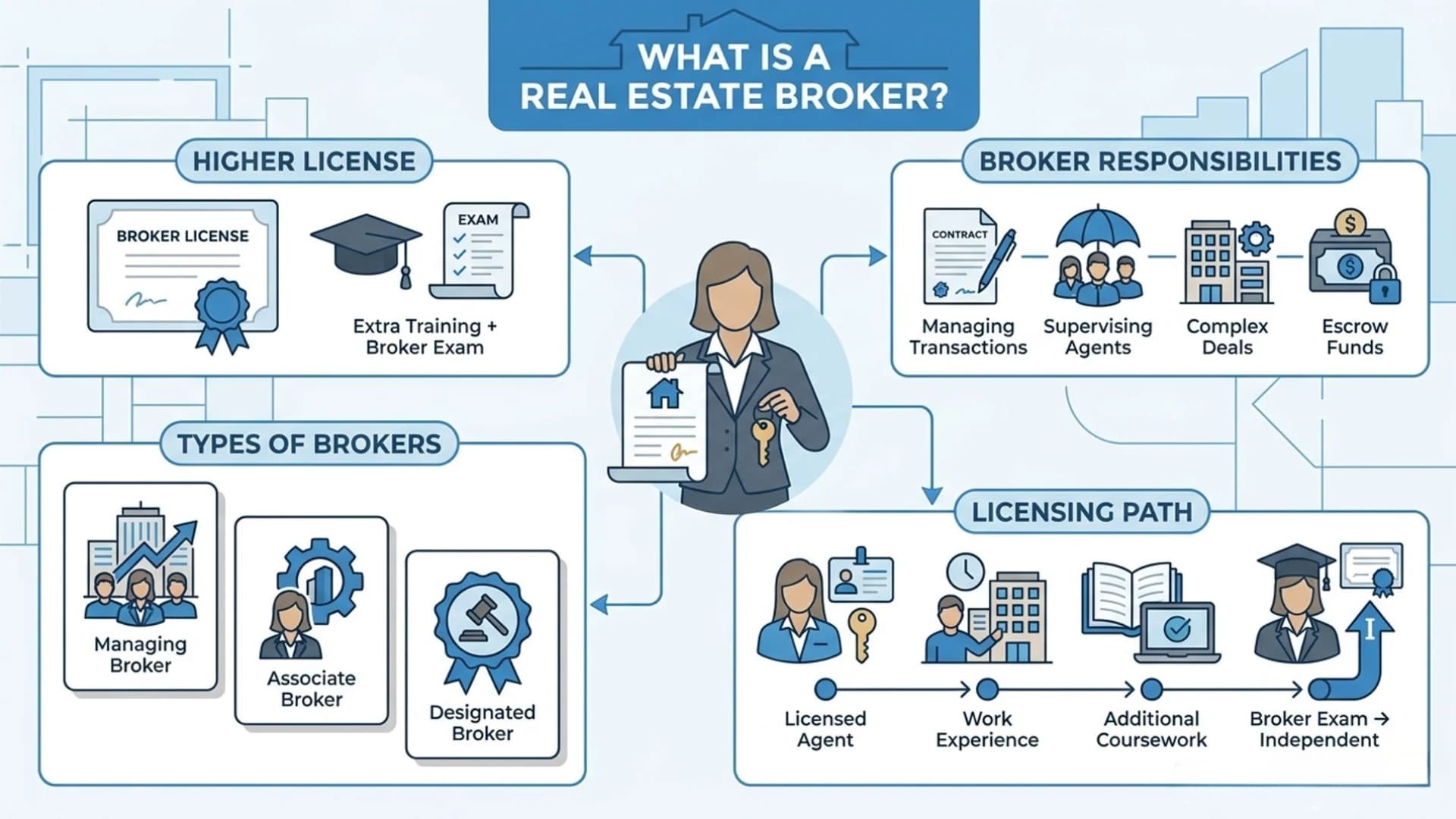
A real estate broker holds a higher license than a standard agent. They have completed more coursework, passed a separate broker exam, and can work without supervision. A broker can open their own brokerage and hire other agents to work under them.
What Does a Broker Do?
- Manages transactions from start to finish. Brokers oversee contracts, disclosures, and closing paperwork to keep deals legally sound.
- Supervises licensed agents. Brokers run their own office and take legal responsibility for every agent working under them.
- Handles complex or high-value deals. Brokers often step in for commercial property, new construction, or transactions with unusual legal issues.
- Holds escrow funds. In many states, only a licensed broker can legally hold a buyer’s earnest money deposit.
Types of Real Estate Brokers
Not all brokers do the same job. There are three distinct types:
- Principal or Managing Broker: Runs the brokerage, takes legal responsibility for all agents, and oversees business finances.
- Associate Broker: Holds a broker’s license but chooses to work under another broker rather than run an office independently.
- Designated Broker: Listed with the state as the person legally responsible for a specific brokerage location.
Broker Licensing Requirements
Requirements vary by state. Most brokers must first become a licensed agent and work under supervision for one to three years. After that, they complete additional coursework, typically 60 to 90 classroom hours, and pass a separate broker exam.
Some states require a minimum number of closed transactions before a person can apply. Many states also require background checks and errors and omissions insurance. Brokers renew their license through continuing education every one to two years.
What Is a Realtor?
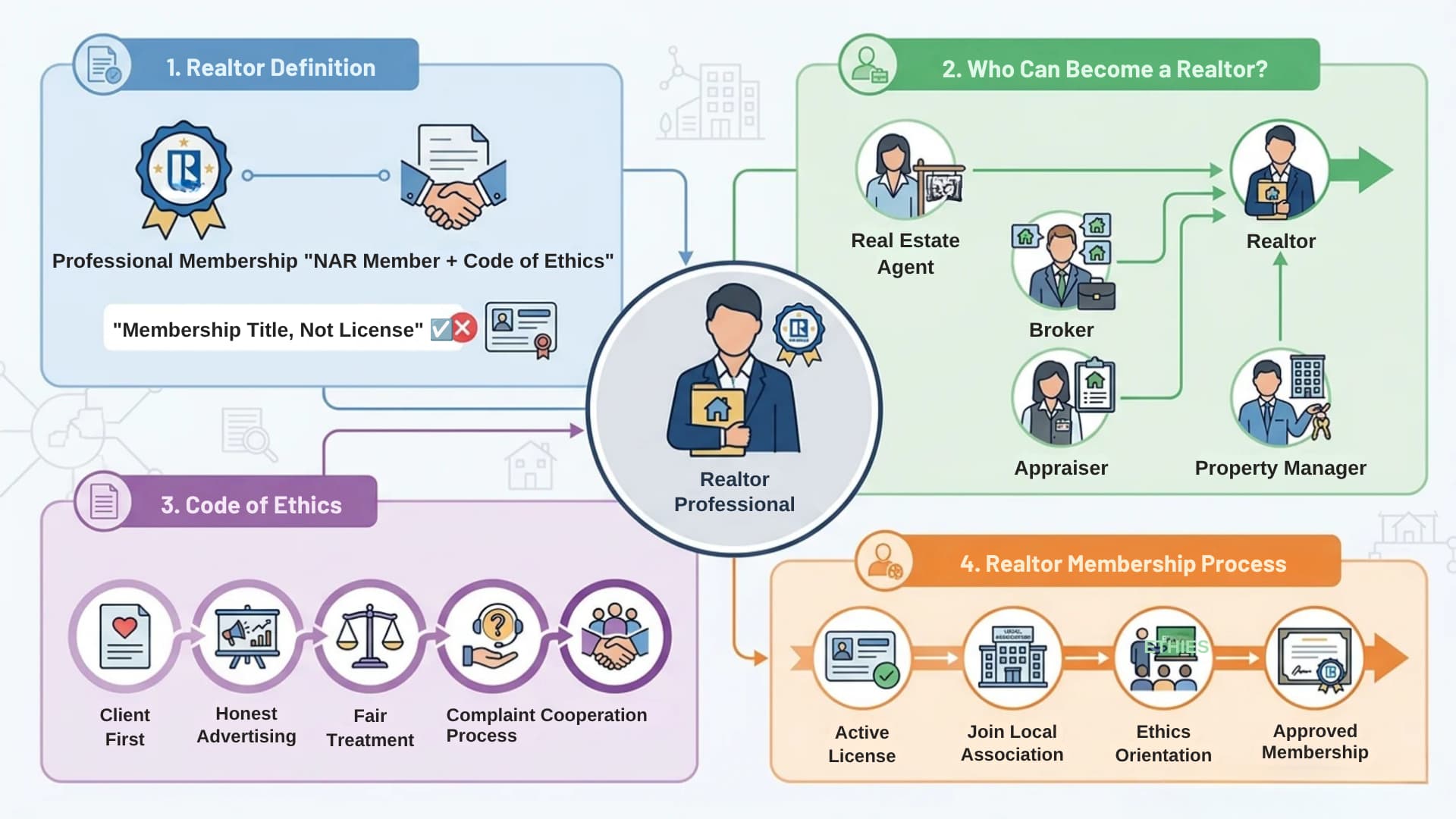
A Realtor is any real estate professional, agent, or broker who joins the National Association of Realtors (NAR) and agrees to follow its Code of Ethics. Realtor is a registered trademark, not a job title earned through licensing.
Who Can Become a Realtor?
Licensed agents, brokers, appraisers, and property managers can all become Realtors. The only requirement is an active real estate license and membership in a local NAR-affiliated association.
The process takes a few weeks and includes a short ethics orientation course. Most associations also require a background check before approving new members. Dues are billed annually and vary by state and local association.
What Does the NAR Code of Ethics Cover?
The Code covers 17 articles. These are the core rules that matter most to buyers and sellers:
- Puts client interests first. Realtors must disclose material facts and cannot misrepresent a property’s condition.
- Requires honest advertising. Listings and marketing must be accurate and cannot mislead buyers or sellers.
- Bans discrimination. The Code prohibits treating clients differently based on race, religion, national origin, or other protected classes.
- Sets a complaint process. Clients can file an ethics complaint through their local association. Penalties range from fines to membership loss.
- Requires cooperation. Members must share accurate information with other agents to keep deals moving fairly.
According to NAR data, 81% of home purchase contracts involve at least one Realtor on either side of the deal.
Can a Broker Also Be a Realtor?
Yes. A broker who joins NAR holds both a higher license and a membership-based ethics commitment at the same time. The two titles are not competing categories. They solve two different problems.
The license proves legal qualification. The membership proves ethical accountability. Clients often see the Realtor trademark next to a broker’s name in listings and marketing. That combination is one of the strongest signals of professionalism a real estate professional can offer.
Any broker with an active license can apply for NAR membership through their local association. They must pay dues and agree to the Code of Ethics. Once approved, the broker’s name appears in NAR’s official Realtor directory, and they gain MLS access if they did not already have it.
Which Professional Has the Most Authority?
A broker sits at the top of the chain. Only a broker can supervise agents, hold escrow funds, and open a brokerage. That gives the license real legal weight.
Realtor status does not climb that ladder. It sits alongside it as an ethics commitment layered on top of whatever license someone already holds.
A standard agent sits at the bottom. Even a highly experienced agent must work under a supervising broker. That applies regardless of tenure or NAR membership. That requirement holds across every state, even when the finer details of broker duties shift with local licensing law.
Common Misconceptions About Brokers and Realtors
Myth: Every broker is a Realtor. Not true. Brokers only become Realtors if they choose to join NAR and pay dues. Plenty of licensed brokers operate without ever joining.
Myth: Realtors have a higher license than agents. Not true. Realtor is a membership title, not a license level. An agent, broker, or property manager can all hold Realtor status with the same license they already had.
Myth: Brokers always cost more. Not true. Commission rates depend on the agreement and local market. Some brokers charge the same rate as agents in their area.
Myth: Only Realtors can sell homes. Not true. Any licensed agent or broker can legally sell property. Realtor membership adds an ethics commitment, not legal permission to sell.
Who Should You Hire?
The right choice depends on how complex your deal is and what level of accountability matters to you.
- Hire a broker for complex transactions such as commercial property, new construction, or deals with unusual legal or financial issues. Their extra training and legal authority matter most when a deal has more moving parts than a standard home sale.
- Hire a Realtor when you want someone bound by a written ethics code with a formal complaint process. This matters most for buyers and sellers who want an added layer of accountability beyond state licensing law.
- A standard agent is enough for a straightforward residential purchase or sale. This is especially true when they work under an experienced supervising broker and have strong local market knowledge.
The average buyer’s agent commission in the U.S. was 2.42% in 2025, according to Redfin. That figure applies whether the agent is a broker, a Realtor, or neither. Commission rates are fully negotiable between clients and real estate professionals.
Frequently Asked Questions
Is a broker better than a Realtor?
They measure different things. A broker has a higher license. A Realtor has an ethics commitment. The better choice depends on your transaction type and what accountability you need.
Can an agent call themselves a Realtor?
Yes, if they join NAR and pay annual dues. Not all agents do. Realtor is a registered trademark and can only be used by active NAR members.
Do brokers charge higher commission than agents?
No. Commission rates depend on the deal and local market, not the license level. Rates are fully negotiable between the client and the professional.
What does the NAR Code of Ethics require?
It covers 17 articles. Core rules include putting client interests first, honest advertising, and banning discrimination. Violations can result in fines or loss of membership.
Does a Realtor have more authority than a standard agent?
No. Realtor status adds an ethics commitment, not legal authority. Both a Realtor and a standard agent must work under a supervising broker unless they also hold a broker’s license.
Broker vs Realtor: The Final Verdict
A broker is a licensing level earned through extra education and a state exam. A Realtor is a professional membership that agents or brokers can choose to join. Neither title beats the other. They measure different things.
Think of it this way. The license tells you what someone is qualified to do. The membership tells you what someone has promised to do.
When choosing a broker vs realtor, match the professional to your deal. Pick a broker when the transaction is complex. Lean toward a Realtor when you want a written ethics commitment backing the relationship. In many cases, the person you work with will hold both titles at once.